

Quick Summary
Worn Harley engine mounts usually show up as excess vibration through the handlebars, seat and footpegs, plus clunks or knocks when you roll on or off the throttle. Check the rubber isolators for cracks or flattening, and check the mounting bolts for looseness. A visible gap at a mount or an engine that sits off-center also points to worn engine mounts.
- Check engine mounts with the bike cool, on its stand, and the engine off.
- Cracked, torn or flattened rubber isolators are a clear sign of worn mounts.
- Re-torque mounting bolts to the service manual spec; do not guess the value.
- Replace mounts as a set so the engine sits evenly.
- Check steering head bearings and swingarm bushings too, since mounts alone won't fix wobble.
Table of Contents
- What Harley Engine Mounts Do and Why Wear Matters
- Harley Engine Mount Symptoms You Can Feel at the Handlebars
- Visual and Physical Checklist for Worn Mounts
- Step-by-Step Motorcycle Engine Mount Inspection
- Why Worn Mounts Can Mimic a Harley Touring Motorcycle Wobble
- When Engine Mount Replacement Is the Right Fix
- Booking a Chassis Check Before Your Next Long Ride
- Frequently Asked Questions
What Harley Engine Mounts Do and Why Wear Matters
Last Updated: November 15, 2026
Engine mounts hold your Harley's engine and transmission to the frame and absorb the vibration the engine makes. Over time, the rubber isolators and metal bushings in those mounts wear, crack or loosen. When that happens, you start to feel it at the handlebars, the seat and the footpegs. This guide is written so US riders of Road Glide, Street Glide and CVO Touring models can recognize the early signs before they turn into a bigger problem.
Engine mount wear is easy to miss. Most riders assume a new buzz or clunk is a carburetor, tire or exhaust issue. A worn mount can cause the same feelings, so it pays to check the mounts before you start replacing parts that may be fine.
Why does wear matter? A loose mount lets the engine move more than it should. That movement can stress nearby wiring, cables and the frame. It also changes how the bike feels under throttle, which affects control at speed.
- Engine mounts hold the powertrain to the frame
- Rubber isolators soak up engine vibration
- Worn parts let the engine shift under load
- Movement can strain cables, wiring and brackets
Harley Engine Mount Symptoms You Can Feel at the Handlebars
Handlebar feel is often the first sign that a mount is worn. You may notice a change in how the bars buzz or shake. You may also notice a new movement that you did not feel before.
Many riders describe it as the bike feeling "looser" than it used to. That feeling deserves a closer look, especially if it shows up with a new noise.
Excess vibration at idle and cruising speed
A healthy mount keeps the engine's normal pulse from reaching the bars. A worn mount lets more of that pulse through. Watch for buzzing in your grips, mirrors or seat that wasn't there before. Pay attention to whether the vibration changes with rpm or with the throttle.
Vibration that comes and goes can also point to a loose bolt. Check your mounting hardware before you assume the rubber is gone.
Clunks, knocks and movement under throttle
Give the throttle a quick, smooth roll from idle. A clunk or knock as the engine rocks in the frame is a common sign of a worn mount. Note whether the sound happens on acceleration, deceleration or both.
Keep the test short and safe. Do it in a parking lot or on a quiet road, and stay in control of the bike at all times.
Visual and Physical Checklist for Worn Mounts
Use this checklist when the bike is parked, cool and on its stand. Good light helps a lot.
- Rubber isolators show cracks, tears or flattening
- Rubber looks hardened, shiny or pulled away from the metal
- Mounting bolts are loose, missing or have stripped threads
- Bracket welds or mounting tabs show cracks or fresh rust streaks
- Engine sits off-center or shows a gap at one mount
- Cables, hoses or wiring look tight against the frame or rub marks
- Oil or fluid residue appears near a mount (check your bike's service manual for component details)
Step-by-Step Motorcycle Engine Mount Inspection
Work through these steps in order. If anything looks unsafe, stop and have a qualified technician check the bike.
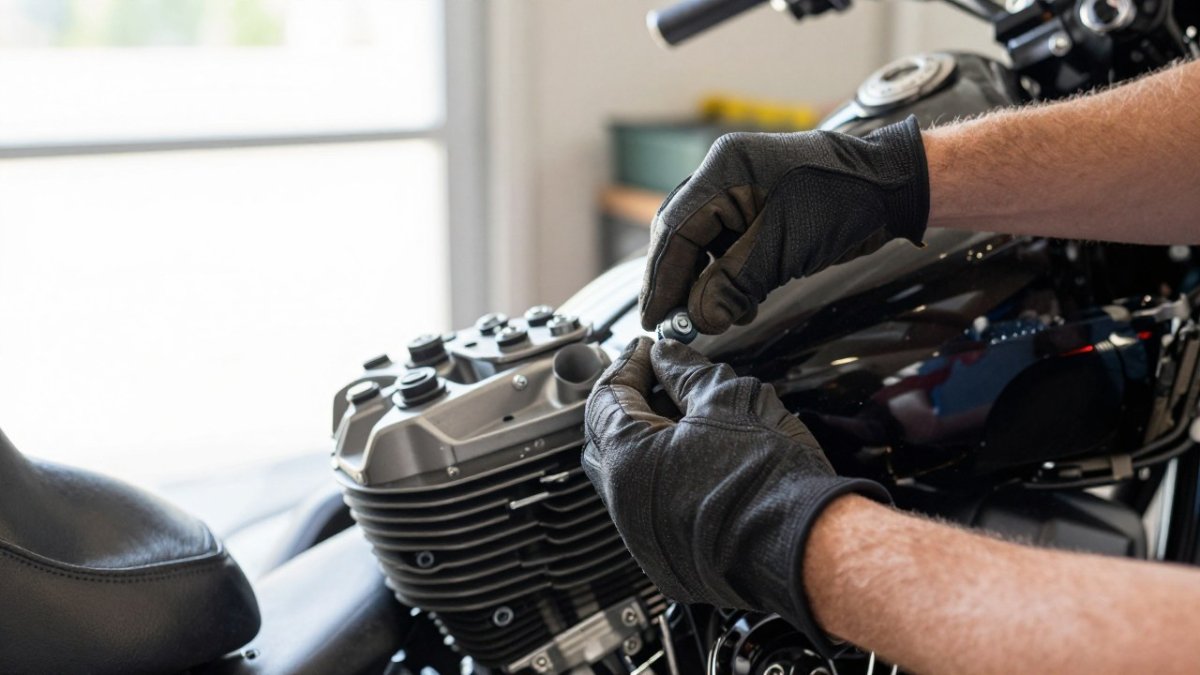
- Park on level ground and let the engine cool. Use the side stand or center stand so the bike is stable. A cold engine matters because rubber isolators soften slightly when hot, which can hide a crack.
- Look at each mount with a flashlight. On Touring models the front engine isolator sits under the front of the engine between the frame downtubes, and the rear stabilizer link ties the transmission case to the frame near the swingarm pivot. Check both, plus the top motor mount on models that use one.
- Gently press on the rubber. Feel for soft, spongy or crumbling spots. A healthy isolator feels firm and springs back; a worn one feels mushy or has visible cracks radiating from the bolt holes.
- Check the mounting bolts. Use the correct torque specification from your Harley service manual for your exact model year. Do not guess. On most Touring models the front isolator-to-frame bolts and the stabilizer link bolts are specified in the service manual's frame section, and the values differ by model year, so a forum number is not a substitute for the manual.
- Try a rocking test. With the bike on its stand, rock the engine by hand at the mount points. Watch for movement against the frame. A small amount of movement is normal; a visible gap opening and closing at the isolator is not.
- Note any noise or movement. Write down where it comes from so you can explain it to a shop. A short phone video of the rocking test is worth more than a description.
A common mistake is over-tightening bolts to stop a rattle. That can crack a bracket or damage threads. If a bolt keeps loosening, the mount or bracket may be the real problem, not the fastener.
Symptom-to-cause matrix. Use this to narrow the diagnosis before you buy parts:
- Buzz in the grips and mirrors that rises with rpm: front engine isolator rubber hardened or cracked.
- Clunk on acceleration or deceleration: rear stabilizer link bushing worn, or a loose mount bolt.
- Engine visibly off-center or a gap at one mount: collapsed isolator or bent bracket.
- Vibration that comes and goes with no pattern: loose bolt or a cracked bracket, not necessarily the rubber.
- Wobble at speed that worsens in crosswinds: check mounts, but also steering head bearings, swingarm bushings and tire pressure before blaming the mounts.
Watch out: a rocking test done with the bike running can let a hand or tool contact a hot exhaust or moving belt, so do the test with the engine off and the bike in neutral.
Helpful tip: Take a short video of the rocking test with your phone. It can help you compare the bike over time and show a technician what you saw.
The article's inspection steps lead to a symptom-to-cause matrix that narrows the diagnosis before you buy parts.
| Symptom | Likely cause | Next step |
|---|---|---|
| Buzz in grips and mirrors that rises with rpm | Front engine isolator rubber hardened or cracked | Inspect and replace the isolator |
| Clunk on acceleration or deceleration | Rear stabilizer link bushing worn or loose mount bolt | Check bushing and re-torque bolts |
| Engine visibly off-center or gap at one mount | Collapsed isolator or bent bracket | Check bracket and isolator |
| Vibration that comes and goes with no pattern | Loose bolt or cracked bracket | Re-torque and inspect bracket |
| Wobble at speed that worsens in crosswinds | Mounts, steering head bearings, swingarm bushings or tire pressure | Check all sources before blaming mounts |
Why Worn Mounts Can Mimic a Harley Touring Motorcycle Wobble
Worn mounts can make a touring bike feel unsettled at speed. Engine movement can change how the front end and rear end react to bumps, crosswinds and quick steering inputs.
Because of this, riders sometimes blame the steering damper or front end first. A wobble that starts at speed does not always come from one cause. Check the mounts, bolts and bearings before you decide what is wrong.
Keep this in mind: a worn mount does not replace a proper stability check. If the bike shakes hard at speed, slow down, stay off the throttle and get the bike looked at promptly.
For more on speed-related wobble, see how to reduce handlebar vibration on Harley touring bikes and how to fix Harley death wobble.
When Engine Mount Replacement Is the Right Fix
Replacement makes sense when you find cracked rubber, collapsed isolators, bent brackets or bolts that keep loosening even after proper torque.
Replace now if any of these are true:
- The isolator rubber is cracked through, torn, or pulled away from the metal insert.
- The isolator has collapsed so the engine sits visibly lower or off-center.
- A bracket is cracked or a mounting tab is bent.
- A bolt will not hold torque after a proper re-torque to the service manual spec.
- You feel a clunk under throttle that you can reproduce in a parking-lot rocking test.
Monitor and re-check if:
- The rubber looks aged but is not cracked, and the bike still feels normal.
- You found a loose bolt that held torque after re-tightening.
- The vibration is mild and has not changed over several hundred miles.
Mounts are usually replaced as a set so the engine sits evenly. Replacing one isolator while the others are hardened can leave the engine misaligned and shorten the life of the new part.
What it costs. Pricing depends on the parts you need, your model year and the shop you use. Ask for an itemized quote rather than relying on a single number.
Check these at the same time. A worn mount rarely fails alone.
Watch out: replacing mounts without checking steering head bearings and swingarm bushings can leave a wobble in place, because a new isolator will not fix play elsewhere in the chassis.
Many riders also check nearby parts at the same time. Before you finish, confirm the steering head bearing adjustment and the condition of the swingarm bushings so you do not miss a second source of play.
Booking a Chassis Check Before Your Next Long Ride
If you are unsure whether the symptoms come from the mounts, a professional chassis check can save time and guesswork. Ask the shop to inspect the engine mounts, frame, steering head and suspension together.
Before a long ride, the check should cover:
- Engine mount condition and bolt torque
- Steering head play and bearing condition
- Damper function, if your bike has one
- Tire condition and pressure
If your inspection points to steering stability, you can shop the Death Deleter catalog for current options and pricing for your bike.
BUTTON: Shop Steering Dampers CARD_TITLE: Is your Harley losing stability at speed? CARD_TEXT: Death Deleter makes rebuildable steering dampers and chain tensioners for performance Harley-Davidson touring bikes.
Frequently Asked Questions
Can bad engine mounts cause a Harley to vibrate?
Yes. Engine mounts isolate the engine from the frame, so when the rubber or bushings deteriorate, vibration that would normally be absorbed travels into the handlebars, floorboards and seat. The vibration often changes with rpm and may feel worse at certain speeds. Because vibration has several causes, including tire imbalance, loose fasteners and exhaust issues, rule those out first, then inspect the mounts for cracked rubber, play and loose hardware.
Can worn engine mounts cause a Harley touring motorcycle wobble?
Worn mounts can contribute to instability because a loose engine can shift under load, making the bike feel unsettled in corners or at speed. However, a true high-speed wobble usually points to steering, tire, or chassis causes. If the wobble persists, check the engine mounts as one part of a broader inspection rather than assuming they are the sole cause. A shop should evaluate the whole front end and drivetrain.
How do you check Harley-Davidson engine mounts?
Start with a visual check for cracked, hardened or squashed rubber isolators and any missing hardware. Then, with the engine off and the bike stable on its stand, try to move the engine by hand and watch for excessive movement or metallic clunks. Confirm all mount bolts are torqued to the factory specification in your service manual. If you find play or damage, have a qualified technician verify the findings before riding.
Can you ride a Harley with a bad engine mount?
Riding with a damaged engine mount is not recommended. A loose mount can allow the engine to move, stress nearby components, and affect handling. Stop riding and have the bike inspected promptly if you notice new vibration, clunking, or handling changes. A mount that fails at speed can compromise control, so treat the symptom as a safety issue.
