
Quick Summary
Death wobble is a violent, self-sustaining oscillation of the front wheel and handlebars that can throw a rider off a motorcycle within seconds. Preventing it on Harley touring bikes means keeping tire pressure correct, steering-head bearings adjusted, rear alignment square, and the load balanced.
- Death wobble is usually triggered at speed, often between 60 and 80 mph, and it feeds on itself.
- Check cold tire pressure against the sticker on the swingarm or the owner's manual before every ride.
- Lift the front wheel off the ground to check steering-head bearings for play.
- Remove tour pack contents and retest on the same road to see whether load is contributing.
- Stop riding and get a professional inspection if the wobble returns after your checks.
Table of Contents
- What Death Wobble Is and How It Differs from Weave and Shimmy
- What Causes Motorcycle Death Wobble on a Touring Bike
- Model-Year Inspection and Maintenance Checklist for Harley Touring Bikes
- Diagnostic Sequence: Separating Front-End, Rear-End, Tire, and Load Causes
- Harley Death Wobble Fix: Adjustments, Repairs, and Load Management
- Motorcycle Death Wobble Stabilizer: Comparing Steering Dampers and Upgrades
- Motorcycle Wobble Recovery and When to Stop Riding for Inspection
- Frequently Asked Questions
Preventing Harley Death Wobble on Touring Bikes
Last Updated: November 19, 2026
What Death Wobble Is and How It Differs from Weave and Shimmy
Death wobble is a violent, self-sustaining oscillation of the front wheel and handlebars that can throw a rider off a motorcycle within seconds. This guide covers how to prevent it on Harley-Davidson touring bikes, how to diagnose its causes, and what to do when it starts.
Death wobble is usually triggered at speed, often between 60 and 80 mph, and it feeds on itself. The front end swings left and right, each swing gets larger, and the handlebars can jerk hard enough to tear the grip out of a rider's hands.
Riders often mix up three similar behaviors. A weave is a slower side-to-side motion of the whole bike, typically caused by rear-end or load problems. A shimmy is a rapid, low-amplitude vibration of the front wheel, often tied to tire or wheel imbalance. A headshake is a smaller oscillation of the handlebars that usually stays within a manageable range.
Telling these apart matters because each one points to a different fix. For a step-by-step death wobble fix guide covering each repair, see the full walkthrough.
What Causes Motorcycle Death Wobble on a Touring Bike
Death wobble rarely has a single cause. It develops when several small problems combine, and on touring models the most common contributors are:
- Steering-head bearings that are too loose or too tight, or have worn unevenly
- Low or uneven tire pressure, which changes the steering geometry
- Rear-wheel misalignment, often after a wheel, tire, or chain service
- Worn suspension components, including fork seals, shock bushings, and swingarm bushings
- Loose spokes or wheel runout that throws off balance at speed
- Heavy or unevenly distributed loads on the tour pack, sissy bar, or saddlebags
What the list does not show is how these factors feed each other.
Speed, load, road surface, and wind interact rather than acting alone.
Tire pressure deserves its own note because it changes the shape of the contact patch and the effective steering geometry.
Aftermarket changes matter too. A heavier exhaust, a larger windshield, a different tire profile, or a changed ride height can shift weight distribution or steering geometry enough to trigger a problem that was previously marginal.
Wobble is often the result of several small issues at once rather than one big failure.
Model-Year Inspection and Maintenance Checklist for Harley Touring Bikes
Touring models share a platform, but their steering and suspension details vary by year and by configuration, so a model-aware checklist is more useful than a generic one. Use the owner's manual and a Harley-Davidson dealer for torque specs and service intervals for your exact bike. Work through these items at every service and before any long ride.
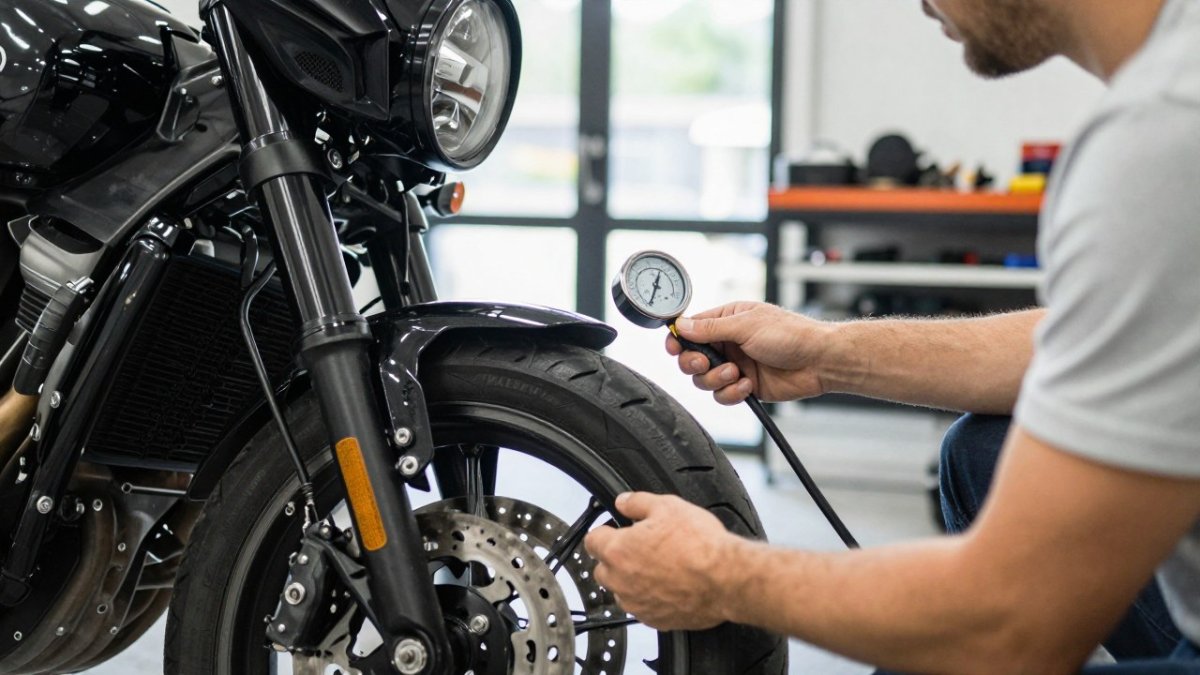
- Tire pressure: Check cold pressure against the sticker on the swingarm or in the owner's manual, front and rear, every week or before each ride
- Tire condition: Look for uneven wear, cupping, cracks and embedded debris
- Wheel runout and spokes: Spin each wheel and watch for wobble. Check spoke tension on spoked wheels
- Steering-head bearings: Lift the front wheel off the ground and check for play. Feel for notchiness when turning the bars lock to lock
- Fork condition: Look for oil seepage, scoring on the stanchions and uneven fork height
- Rear-wheel alignment: Confirm chain adjusters are set evenly on both sides after any rear wheel work
- Swingarm and shock bushings: Check for play at the pivot points
- Load and luggage: Confirm the tour pack and saddlebags are balanced and within the rated load
Keep a written log of each check. Patterns, such as a front tire that keeps losing pressure, are often the first clue to a developing problem.
Diagnostic Sequence: Separating Front-End, Rear-End, Tire, and Load Causes
When wobble starts, a structured sequence keeps you from guessing and from replacing parts before you know what is wrong.
Step 2: Load. Remove the tour pack contents, rebalance the saddlebags, and take a short ride on the same road.
Step 3: Rear-end alignment. Confirm the rear wheel tracks straight with the front.
Step 4: Steering-head bearings. Lift the front wheel off the ground and grasp the fork lowers.
Step 5: Suspension and bushings. Look for fork oil seepage, scoring on the stanchions, and uneven fork height.
If every check passes and the wobble persists, stop adjusting and get a professional inspection.
| Step | What to check | Key point |
|---|---|---|
| 1. Tires and wheels | Cold pressure, tread, runout, spoke tension | Cheapest cause to rule out and the most common |
| 2. Load | Remove tour pack contents, rebalance saddlebags, retest | Weight far behind the axle unloads the front tire |
| 3. Rear-end alignment | Compare swingarm-to-axle measurements on each side | Misalignment often shows up as a weave |
| 4. Steering-head bearings | Play when lifting the front wheel, notchiness lock to lock | Loose or over-tightened bearings show up here |
| 5. Suspension and bushings | Fork oil seepage, stanchion scoring, swingarm and shock play | Worn parts make the front end feel vague first |
Harley Death Wobble Fix: Adjustments, Repairs, and Load Management
Once you have found the likely cause, address it directly.
Adjust steering-head bearings. Bearing adjustment is precise work. Follow the service manual's procedure, set the preload correctly, and recheck for smooth, play-free steering.
Restore rear alignment. If the rear wheel was removed, set the chain adjusters so the wheel sits square to the frame.
Replace worn components. Worn fork seals, loose spokes and tired bushings should be fixed rather than ridden on.
Manage load deliberately. Keep heavy items low and centered, and avoid overpacking the tour pack.
Ride with caution in the meantime. Reduce speed, keep a firm grip without locking your arms, and avoid heavy braking in a wobble.
Motorcycle Death Wobble Stabilizer: Comparing Steering Dampers and Upgrades
A steering damper adds resistance to rapid steering movement, which can help prevent oscillation from building. It supports good maintenance and correct setup rather than replacing them.
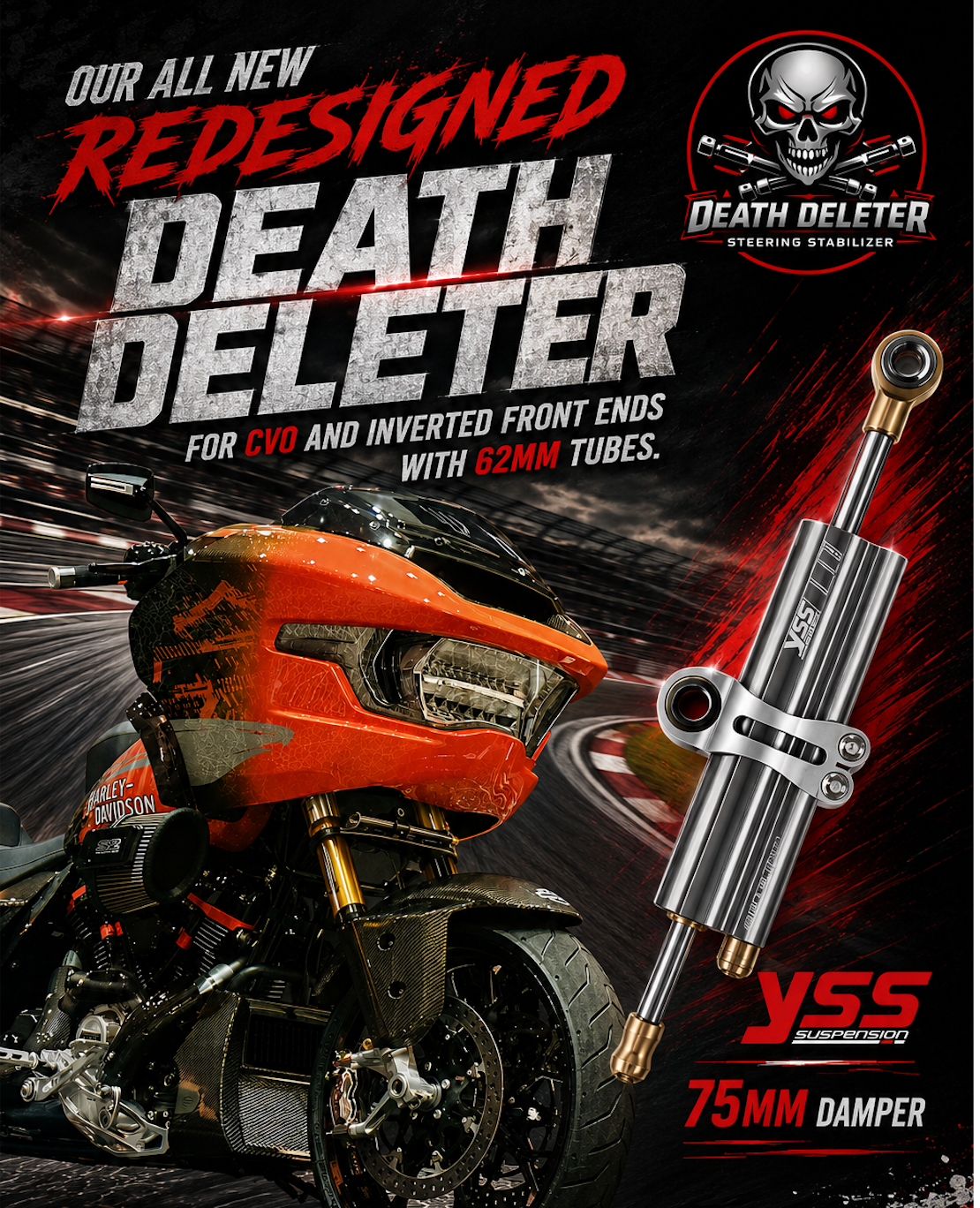
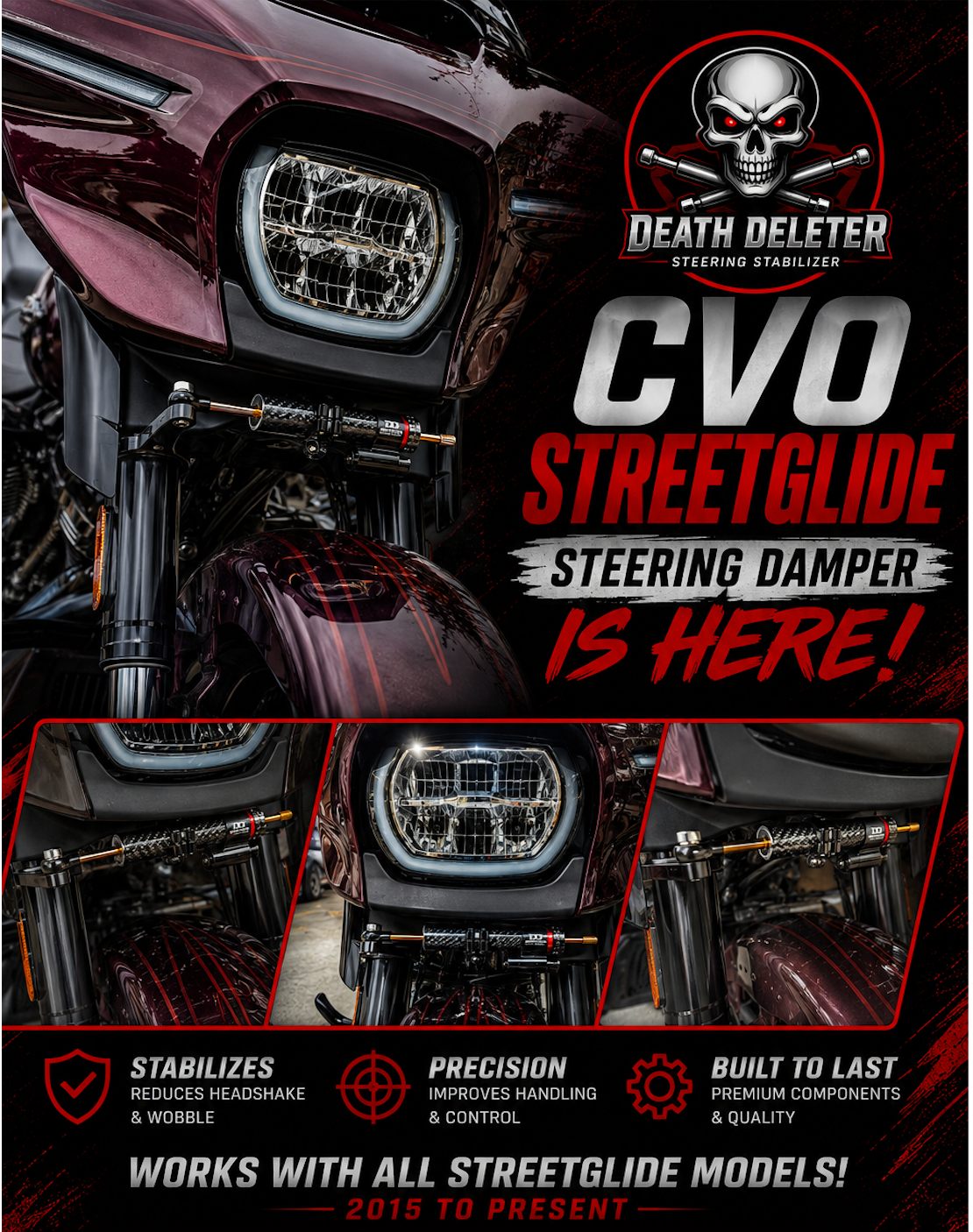
Death Deleter's steering stabilizer kits are built around a rebuildable, fully adjustable YSS steering damper and an application-specific mounting system, designed for 2015-2026 Harley-Davidson touring models: compare touring steering stabilizers in the complete guide before you choose:
- Death Deleter Harley-Davidson Road Glide & CVO Steering Stabilizer 2015-2026 fits the full Road Glide range, including standard and CVO forks. It includes three shims covering 49-62 mm fork sizes, a black YSS damper and a choice of Gold, Black or Clear Anodized bracket finish for $675.
- Death Deleter Harley-Davidson Street Glide Steering Stabilizer 2015-2026 covers the Street Glide range with the same shim system, damper and finish choices, also $675.
Before buying any stabilizer, confirm it matches your model year and fork size, and check that your steering head bearings and tires are already sound. Also check that the mounting system clears your existing hardware. Stabilizers are most useful as part of a complete maintenance routine, not as a substitute for one.
Motorcycle Wobble Recovery and When to Stop Riding for Inspection
If wobble develops, stay calm and keep both hands on the bars. Reduce throttle gradually, avoid sudden braking or steering inputs, and bring the bike to a stop in a safe place as soon as you can.
Stop riding and have the bike inspected by a professional if any of these apply:
- The wobble returns after you have checked tires, load and bearings
- You notice loose or play-filled steering that you cannot adjust
- Fork seals leak or the forks feel uneven
- The rear wheel or chain alignment is in doubt after recent work
- Wobble happens at low speed or without any clear trigger
Riding a bike with an active wobble problem puts you at serious risk. A short tow or a trip to a qualified shop costs far less than an accident.
Ready to add stability to your Harley? Shop Death Deleter's steering stabilizer kits for your model year and ride with more control. Choose your bracket finish and get the kit that matches your fork setup.
Frequently Asked Questions
Which Harleys are prone to death wobble?
Large touring models are the most commonly reported, including Road Glide and Street Glide variants, because their weight, long wheelbase, fairing and saddlebag or tour-pack loads raise the stakes of any steering or tire issue. Wobble is not limited to one model year, though. Owners of any Harley touring bike should check steering-head bearings, tire condition, wheel alignment and luggage load, since these causes apply across the range. Model-specific inspection points are the most reliable way to narrow the risk on your bike.
What causes Harley Davidson's death wobble?
The most common causes are low or uneven tire pressure, worn or improperly adjusted steering-head bearings, misaligned wheels, worn suspension components or swingarm bushings, loose spokes, and heavy or unbalanced luggage. Riding style and road conditions can trigger an existing problem. Work through these causes systematically rather than assuming one cause. A stabilizer can help control oscillation, but it does not replace correcting the underlying mechanical condition.
At what speed does a death wobble start?
Speed wobble typically begins at highway speeds, often between roughly 50 and 80 mph, and is more likely at higher speeds when a mechanical issue is present. The exact speed varies by bike, load, tire condition and road surface. Because the speed at which it starts differs from rider to rider, the safest approach is to treat any wobble at any speed as a warning and reduce speed gradually with a firm grip. Do not assume a specific speed means your bike is safe below it.
Can worn tires or incorrect tire pressure cause a Harley to wobble?
Yes. Low or uneven tire pressure and worn or cupped tires can change how the front and rear tires track the road, which can initiate or worsen oscillation. Check pressure with a quality gauge when the tires are cold, and follow the pressure specified for your model and load. Inspect the tread and sidewalls for wear, cupping, flat spots and damage. Tire problems are one of the easiest causes to check and correct, so start there.
Can a steering damper help reduce motorcycle wobble?
A steering damper can help resist rapid steering oscillation, which is the movement that defines a death wobble. The Death Deleter Harley-Davidson Road Glide and CVO kit and the Street Glide kit each include a high-performance, fully adjustable and rebuildable YSS steering damper, priced at $675 in each color option. It is a control aid, not a substitute for mechanical inspection.
What should I do if my motorcycle starts wobbling at speed?
Stay calm, grip the handlebars firmly with both hands, and avoid sudden braking or steering inputs. Roll off the throttle gradually and let the bike slow down. Use the rear brake lightly to help stabilize it if the situation allows, and avoid heavy front braking while the front end is oscillating. Once the bike is stable and safely stopped, check tire pressure, luggage load and steering-head bearings before riding again.
When should I stop riding and have a Harley checked for wobble?
Stop riding and have the bike inspected by a qualified technician if the wobble returns after you have checked tire pressure and load, if you feel play in the steering head, if you notice uneven or cupped tire wear, or if the wobble appears at low speed. Any wobble that is severe or happens repeatedly should be treated as a safety issue. A professional inspection can confirm whether the steering-head bearings, alignment or suspension need repair before you continue riding.
Does a Death Deleter stabilizer void my Harley warranty?
Installing aftermarket components can affect warranty coverage, and the outcome depends on your dealer and the specific claim. Before you install a steering stabilizer or chain tensioner, check with your Harley-Davidson dealer about how the added parts may affect coverage. Keep records of your installation and maintenance, and have a qualified shop verify that the mounting and steering system are correctly set up after installation.
