
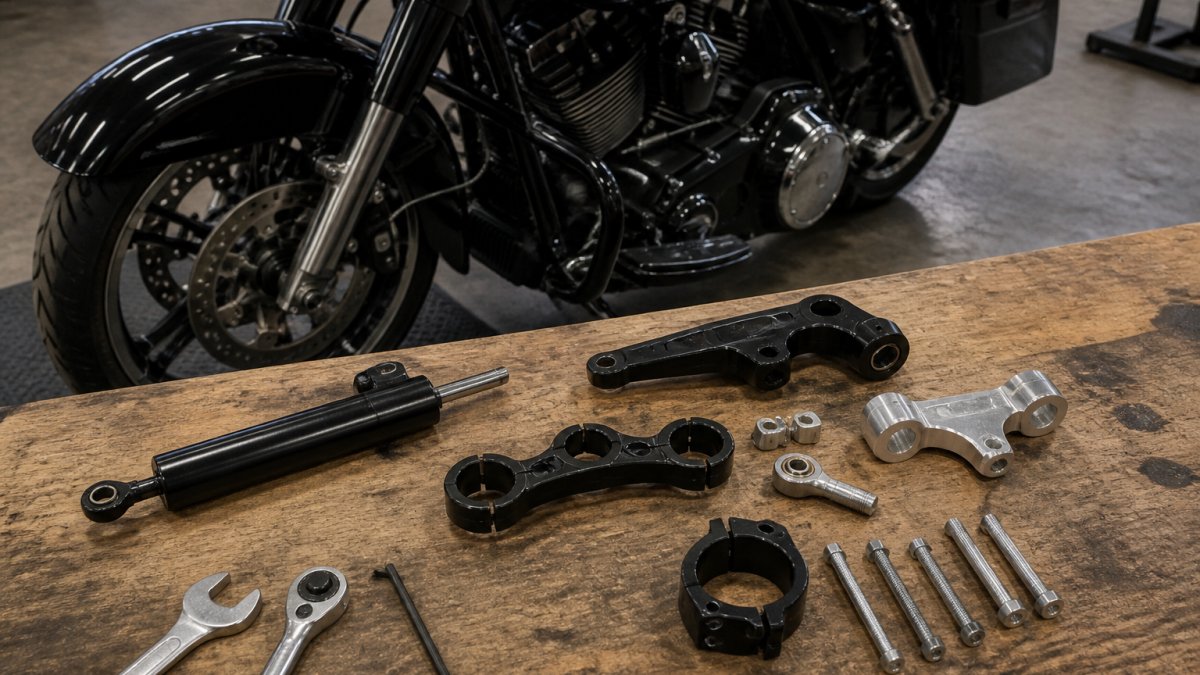
Last Updated: October 25, 2026
Quick Summary
Suspension geometry touring bikes depends on how preload, sag, and load distribution interact with your frame's rake and trail to maintain stability with luggage and passengers at highway speeds. Proper setup requires measuring static sag of 30-40mm and dynamic sag of 50-70mm, then adjusting rear preload to preserve effective rake and trail as the rear suspension compresses under load.
- Measure dynamic sag with full touring load to determine actual riding geometry, not static sag alone.
- Rear preload is a geometry tool that preserves ride height and trail when carrying a passenger and luggage.
- Heavy touring bikes typically run 26-30 degree rake angles and 5.5 to 6.5 inches of trail.
- Loading the bike reduces effective rake by 0.5 to 1.5 degrees and trail by 0.2 to 0.5 inch, quickening steering response.
- Target 25-30% front sag and 30-35% rear sag under full load to maintain balanced weight distribution.
Table of Contents
- What Suspension Geometry Means for Touring Motorcycles
- Motorcycle Suspension Sag for Touring Loads
- Touring Motorcycle Rake and Trail Effects on Handling
- Diagnosing and Fixing Touring Motorcycle Front-End Wobble
- Front and Rear Suspension Balance for Loaded Touring
- Getting Your Touring Bike Setup Right
- Frequently Asked Questions
What Suspension Geometry Means for Touring Motorcycles
Suspension geometry for heavy touring bikes isn't about spring stiffness, it's how frame angles, travel, and weight distribution keep you stable with luggage, a passenger, or both at highway speeds.
A bike stable at 60 mph with luggage can turn twitchy at 80 mph. This isn't a defect, it's a geometry problem tuning alone can't fix.
Understanding suspension geometry touring bikes means recognizing that stability depends on how preload, sag, and load distribution interact with your frame's inherent geometry.
Motorcycle Suspension Sag for Touring Loads
Sag is how much your suspension compresses under the weight of bike, rider, and cargo or passenger. Measure it first, it determines how much travel remains for bumps.
There are two types: static sag (bike and rider) and dynamic sag (bike, rider, and passenger or luggage). For touring, dynamic sag matters more, it's your actual riding condition.
Measuring Sag on Your Touring Bike
Start on level ground with a measuring tape and a helper.
Measure from a fixed reference point, rear axle bolt or fender, to the ground with the bike standing alone, engine off.
For touring, add your typical passenger weight and luggage load, then remeasure. This is your dynamic sag.
Watch out: if dynamic sag exceeds 75% of rear travel, you've run out of room to absorb impacts.
Adjusting Preload for Luggage and Passenger Weight
Preload is the initial compression of your rear spring before any weight sits on the bike, more preload means less sag.
Most touring bikes have adjustable rear shock preload, usually a collar at the shock base.
Measure static sag with just you on the bike.
Once static sag is dialed in, add passenger and luggage and measure dynamic sag. Within 50-70mm, you're set.
Touring Motorcycle Rake and Trail Effects on Handling
Rake is the front fork's angle relative to vertical; trail is the horizontal distance between the front tire's contact patch and where the steering axis intersects the ground. Together they define how the bike steers and how stable it feels at speed.
Heavy touring bikes typically run rake angles of 26-30 degrees and trail figures around 5.5 to 6.5 inches (roughly 140-165mm). A fully faired model with a long wheelbase sits at the slacker end; a stripped-down bagger may run steeper. More trail increases self-centering force at the contact patch, keeping a 900-pound loaded bike tracking straight at 75 mph; less trail quickens turn-in but reduces that margin.
What Actually Changes When You Load the Bike
Here's the mechanism most riders miss: adding a passenger and luggage compresses the rear suspension, raising the rear axle relative to the frame and rotating the chassis around the front contact patch. That rotation:
- It reduces the effective rake angle (the fork becomes more vertical relative to the ground).
- It reduces trail, because the steering axis intersection point moves forward relative to the contact patch.
A common pattern is a 0.5- to 1.5-degree reduction in effective rake and roughly 0.2 to 0.5 inch (5-12mm) of trail loss at full touring load. Trail is the primary source of steering stability, so losing even a quarter inch changes how the front end communicates, a bike planted solo can feel vague with a passenger aboard.
Second effect: the rear wheel moves forward slightly in the swingarm arc as the suspension compresses, shortening the effective wheelbase and quickening steering. Reduced trail plus a shortened wheelbase makes the front end more sensitive to bar input and wind gusts than when unloaded.
Why Preload Is a Geometry Tool, Not Just a Comfort Setting
The practical takeaway: rear preload is your primary geometry adjustment for load. Increasing it when you add a passenger and luggage limits rear compression, preserving ride height, effective rake and trail, and steering closer to the designer's intent.
Set preload for solo riding and load the bike without adjusting, and you're riding a different geometry. The fix isn't a new triple tree, it's measuring sag under load and adding preload until the rear sits at the correct height, recovering most of the lost trail.
Rake, Trail, and the High-Speed Wobble Connection
Trail provides the self-centering force that resists oscillation. Learn the specific steps to fix Harley death wobble and restore stability. Reduced by load, the front end has less inherent resistance to wind buffeting, road grooves, or a passing truck, one reason wobble incidents cluster on loaded bikes at highway speed.
That's why a steering damper complements correct geometry rather than substituting for it. Set geometry with preload, then use damping for residual energy.
A Quick Sanity Check You Can Do in the Garage
You don't need an alignment rack. Park on level ground, load the bike as for a trip, and sight along the fork tubes. If the fork looks visibly more vertical than unloaded, the rear sits too low and needs more preload. More precisely, measure rear ride height loaded versus unloaded; if the rear has dropped more than about 1.5 inches beyond target sag, the geometry has shifted enough to feel.
Diagnosing and Fixing Touring Motorcycle Front-End Wobble
Front-end wobble at highway speed is one of the most frightening experiences on a touring bike: the handlebars oscillate rapidly side to side, you can't steer out of it, and it feels like the bike will shake itself apart.
Death Deleter Harley-Davidson Road Glide & CVO Steering Stabilizer 2015–2026 →
Why Wobble Occurs Under Load
Wobble happens when insufficient steering damping, geometry changes under load, and aerodynamic forces align.
The front fork acts like a spring.
This is where steering geometry touring bikes directly impacts safety. A bike with proper rake and trail, combined with adequate damping, resists these oscillations.
Stabilizing Your Touring Bike at Highway Speed
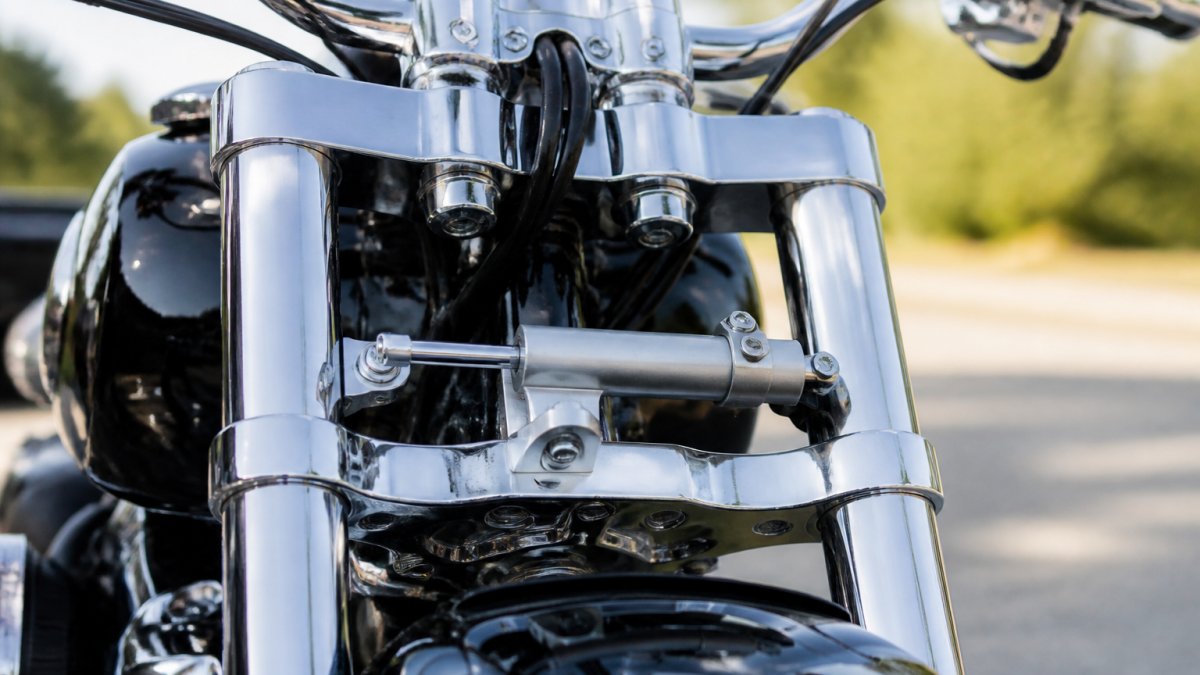
The most effective fix is adding steering damping. A steering stabilizer for Harley touring resists rapid steering movement without making normal turning feel heavy, absorbing the energy that would build into a wobble.
Death Deleter steering stabilizers use high-performance YSS dampers with adjustable resistance, connecting between frame and steering stem to resist oscillation while allowing normal inputs.
Proper suspension geometry touring bikes also requires checking steering head bearing preload.
Front and Rear Suspension Balance for Loaded Touring
Suspension balance means front and rear compress proportionally under load. Learn how to tune bagger suspension for optimal performance with full touring loads. If the front compresses too much, weight transfers forward and steering gets twitchy.
Think in percentages of available travel, not raw millimeters, a 4.7-inch (120mm) fork and 4.5-inch (115mm) shock shouldn't be compared by sag in millimeters alone.
A Repeatable Measurement Procedure
Balance is only meaningful if you measure both ends the same way under the same load:
- Establish a baseline. On level ground, upright and unladen, measure front and rear sag using a fixed reference at each end (fork wiper to triple tree front; axle to fender or frame rear). Record both.
- Measure static sag with rider only. Sit in your normal position, feet on pegs, hands on bars. Have a helper measure both ends. Record.
- Measure dynamic sag with full touring load. Add typical passenger weight and luggage, remeasure both ends. Record.
- Convert to percentages. Divide each sag figure by that end's total travel (from your owner's manual) and multiply by 100 to compare front to rear equally.
- Adjust rear preload first. Bring rear sag into the 30-35% range under full load, then re-measure the front. Correcting rear ride height usually corrects the front's effective load as weight distribution shifts back toward neutral.
- Adjust front preload second, if adjustable. Many touring forks have preload adjusters at the caps. Bring front sag into the 25-30% range under load. No external adjustment means different springs or internal spacers, a spring-rate change, not a tuning tweak.
Geometry Versus Tuning: Know Which Lever You Are Pulling
Some characteristics are fixed by the chassis:
- Fixed by design: rake angle, trail, wheelbase, swingarm length, and the frame's inherent weight distribution. You cannot change these with a clicker.
- Adjustable through setup: ride height (via preload), front-to-rear balance, compression and rebound damping, and, on some shocks, ride height via a length adjuster.
When a loaded bike feels unstable, riders reach for a damping clicker. But if the rear sits an inch too low under load, no damping setting recovers the lost trail. Conversely, if sag is correct and the bike still wallows over repeated bumps, that's a damping problem, rebound too slow, packing the suspension down over impacts. Diagnose the category before adjusting.
Damping Balance Between Front and Rear
Once sag percentages are set, damping balance is the next layer. Compression damping controls how fast the suspension compresses over a bump; rebound controls how fast it extends.
A practical test: ride broken pavement at moderate speed. Front harsh while rear is plush means front compression too firm or rear too soft. Nose-down pitching over dips means front compression too soft or front rebound too slow.
When Balance Problems Point to Something Else
If sag percentages are correct and the bike still feels unbalanced, pulling to one side, wandering, needing constant correction, check tire pressures and wear first, then steering head bearing preload, then swingarm and linkage bearings. A worn bearing or cupped front tire mimics a balance problem, and no preload or damping adjustment will fix it.
Target sag percentages differ between front and rear to maintain balanced load distribution on a touring bike.
| Component | Target Sag | Reason |
|---|---|---|
| Front fork | 25-30% of travel | Lighter load, prevents twitchy steering |
| Rear shock | 30-35% of travel | Carries more weight, intentionally higher |
| Front at 30%, rear at 45% | Unbalanced | Rear works too hard, front skips bumps |
Getting Your Touring Bike Setup Right
Then test methodically: one adjustment at a time, at least 50 miles before judging a change. High-speed stability needs highway miles, not parking lot feel.
For riders experiencing wobble or instability, a steering stabilizer addresses the damping side. Death Deleter steering stabilizers for Road Glide and Street Glide models integrate a high-performance YSS damper with application-specific mounting for the full range of fork sizes and configurations.


On a heavily modified touring bike, upgraded engine, added weight, higher speeds, suspension geometry matters even more.
Start with the fundamentals, sag, bearing preload, damping settings, then add a steering stabilizer if wobble persists. That combination addresses geometry and damping, delivering the stability and confidence heavy touring demands.
Frequently Asked Questions
How much suspension sag should a touring motorcycle have?
Proper sag for a touring bike typically ranges from 25 to 30 millimeters when measured under the rider's weight alone, and an additional 10 to 15 millimeters when luggage or a passenger is added. Sag that is too high (more than 35 millimeters) reduces ground clearance and cornering confidence. Sag that is too low (less than 20 millimeters) creates a harsh ride and reduces traction on rough roads. Measure sag with the bike on a center stand, then again with you seated in normal riding position. The difference is your static sag.
What is motorcycle suspension preload for luggage, and how do I adjust it?
Preload is spring tension that supports your bike's weight and cargo without changing how the suspension compresses. Increasing preload raises ride height and prevents excessive sag under heavy loads. Most touring motorcycles have adjustable preload on the rear shock and fork springs. To adjust, use the preload collar or adjuster wrench (usually included with your bike) and turn clockwise to increase preload. Add preload in quarter-turn increments, then remeasure sag. For a heavily loaded touring bike, you may need 6 to 12 millimeters of additional preload per 50 pounds of cargo.
What causes front-end wobble on a loaded touring motorcycle?
Front-end wobble, often called death wobble, occurs when suspension geometry, steering damping, or weight distribution allows the front wheel to oscillate side to side. Heavy luggage or a passenger shifts the bike's center of gravity forward and upward, making the front end lighter and more prone to rapid steering input. Poor rake and trail geometry, combined with insufficient damping resistance, amplifies this oscillation. A steering damper resists rapid steering movement and stabilizes the front end at highway speeds, preventing the wobble from developing into dangerous oscillation.
How does suspension geometry affect touring motorcycle stability?
Suspension geometry, defined by rake (fork angle), trail (distance from steering axis to contact patch), and wheelbase, determines how your bike responds to steering input and how stable it feels at speed. A steeper rake and longer trail increase stability at highway speeds but reduce cornering agility. A slacker rake and shorter trail make the bike more responsive in turns but can feel twitchy at high speeds, especially under load. For heavy touring bikes, a geometry that favors stability (longer trail, moderate rake) combined with proper sag and damping prevents wobble and builds confidence on long highway runs.
Can a steering damper really help with touring motorcycle wobble?
Yes. A steering damper absorbs energy from rapid steering oscillations and resists quick steering movement without affecting normal riding control. On a properly set up touring bike with correct sag, preload, and geometry, a steering damper prevents wobble from developing at speed and gives you confidence in hard cornering and emergency maneuvers. The Death Deleter steering stabilizer uses a rebuildable YSS damper with adjustable resistance, allowing you to tune damping to your specific bike, load, and riding style.
Proper suspension geometry touring bikes requires understanding how your bike's frame angles, suspension travel, and load distribution interact. Measure your sag, check your bearing preload, and adjust damping methodically. If high-speed wobble persists despite correct suspension setup, steering damping is the proven solution. Death Deleter's steering stabilizers deliver the precision control and adjustability that performance-oriented touring riders need to stay confident at speed.
