

Table of Contents
- Why Stock Harley Suspension Falls Short for Performance Riders
- Harley Steering Damper Solutions: Addressing High-Speed Instability
- Harley Rear Shock Replacement: Ride Quality and Load Capacity
- Harley Front Fork Upgrade: Progressive-Rate Springs and Cartridge Kits
- Best Harley Shocks for a Smooth Ride: Suspension Setup After Installation
- Comparing Upgrade Priorities: Budget and Installation Costs
- Frequently Asked Questions
Last Updated: October 7, 2026
Why Stock Harley Suspension Falls Short for Performance Riders
Stock Harley suspension was engineered for comfort on smooth highways, not aggressive cornering or high-speed stability. Add horsepower or push your touring bike into twisty terrain, and the factory rear shocks and front forks reveal their limitation: they're built for predictable, moderate riding. Performance riders quickly discover stock Harley suspension alternatives exist for good reason, the OEM setup cannot handle modern performance baggers. This guide covers stock Harley suspension alternatives.
The core problem isn't complexity, it's that Harley's factory setup prioritizes cost and comfort over control. Riders who've added performance modifications find the suspension hasn't been upgraded to match, and that mismatch is where aftermarket suspension alternatives make a measurable difference.
Harley Steering Damper Solutions: Addressing High-Speed Instability
A steering damper resists rapid steering movement by creating controlled friction in the steering column. When your front wheel hits a bump at highway speed, or aerodynamic forces push on your fairing, the damper absorbs that energy instead of transmitting it to your hands.
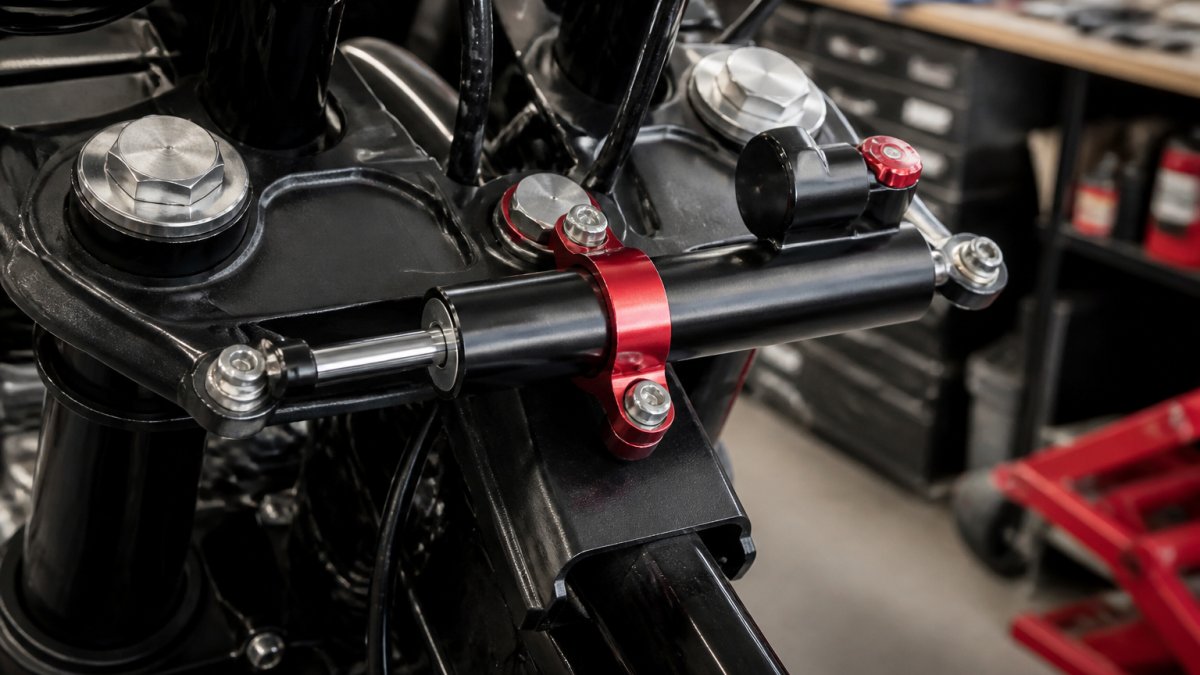
The Death Deleter Harley steering damper kits integrate a high-performance, rebuildable YSS damper with application-specific mounting systems.
How Steering Dampers Resist Rapid Steering Movement
The mechanism is straightforward: a piston moves through oil-filled chambers inside the damper body. As steering input tries to move quickly, the piston encounters resistance, slowing the rate of input and preventing oscillation from building. The result is smoother, more controlled steering without reducing your ability to make deliberate inputs. Adjustable dampers let you dial in resistance, lighter for responsive trail braking, heavier for stability at highway speeds.
Performance riders often confuse steering dampers with power steering. A damper doesn't reduce steering effort; it controls how quickly the steering can move, preserving steering feel while eliminating instability from aerodynamic buffeting or suspension compliance issues.
Model-Specific Fitment and Compatibility
Fitment is where many aftermarket steering damper solutions fail. Universal mounts often require custom fabrication or don't align with your fork configuration.
Before purchasing any steering damper solution, verify your model year and fork configuration match the kit specs. Harley-Davidson changed fork designs across model years and introduced inverted forks on CVO models. A kit for standard forks won't fit inverted forks without modification, and vice versa. Check your owner's manual or contact your dealer if you're unsure which you have.
Harley Rear Shock Replacement: Ride Quality and Load Capacity
Stock Harley rear shocks deteriorate predictably. This is where aftermarket rear shock alternatives become essential.
Rear shock replacement addresses three problems at once: ride quality improves, load capacity increases because you can select shocks rated for your bike's weight plus cargo, and you gain adjustability stock shocks don't offer. Many aftermarket rear shocks include preload adjustment to dial in ride height and spring rate for your weight and riding conditions.
Air Shocks Versus Non-Air Shocks
The core difference: air shocks use pressurized air as part of the spring rate, while non-air shocks rely entirely on steel springs. Air shocks are lighter and more adjustable, since you change spring rate by adjusting air pressure, making them popular for riders who frequently switch between solo and two-up riding. Non-air shocks are simpler and generally less expensive.
For most touring riders, non-air shocks offer long-term reliability. Air shocks require periodic pressure checks and can fail if the seal fails. Non-air shocks, once set up for your weight and load, deliver consistent performance.
Spring Rate, Preload, and Sag Adjustment
Spring rate determines how much force is required to compress the shock. Too soft allows excessive travel and bottoming out; too stiff creates a harsh ride. The correct rate depends on your total weight, rider plus passenger plus luggage.
Preload is the initial tension applied to the spring before any weight is on the shock; adjusting it changes ride height and how the suspension feels over bumps.
Most aftermarket rear shocks include preload adjustment via a threaded collar or spanner wrench, and some add compression and rebound damping adjustment.
Harley Front Fork Upgrade: Progressive-Rate Springs and Cartridge Kits
Stock Harley front forks have limited adjustability. Front fork upgrades address this through cartridge kits and monotube upgrades that replace the internal damping architecture.
Fork Cartridge Kits and Monotube Upgrades
A cartridge kit replaces the internal damping cartridge inside your existing fork tubes. It's less expensive than replacing the entire fork and preserves your original fork appearance, and typically includes adjustable compression and rebound damping for control over braking inputs and bump absorption.
For most riders, a cartridge kit is a practical choice: it costs less, installs in your existing forks, and delivers improvements in control and adjustability. Monotube upgrades are worth considering for a complete fork rebuild or an inverted fork swap as part of a larger suspension project.
Standard Forks Versus Inverted Fork Configurations
Standard forks have the larger diameter tube on the bottom and the smaller on top; inverted forks flip this, with the larger tube on top. Inverted forks are standard on CVO touring models and increasingly common on performance baggers.
Death Deleter Harley-Davidson Low Rider & Softail Steering Damper Kit →
Upgrading from standard to inverted forks changes your bike's handling. Inverted forks require different brake caliper mounting and may need frame modifications, so this is best handled by a shop experienced with your model.
Most riders upgrading their front suspension start with a cartridge kit in their existing forks rather than committing to an inverted fork swap, getting the handling improvements they want at lower cost and complexity.
Best Harley Shocks for a Smooth Ride: Suspension Setup After Installation
Installing new shocks is only half the battle. Proper setup determines whether your new suspension delivers the improvement you're paying for, and many riders leave them at factory preload settings, wasting the adjustability they just purchased. Correct setup takes 30 minutes and transforms ride quality.
Rider Weight, Passenger Load, and Luggage Considerations
Suspension setup must account for your total weight. A 180-pound rider solo requires different preload than the same rider with a 150-pound passenger and 50 pounds of luggage. Many riders set preload once and never adjust it, optimizing for only one scenario, usually solo riding.
The correct approach: establish your typical riding scenario, solo, two-up, or two-up with luggage, and set preload to achieve 25-30% sag with that load.
Luggage weight matters more than most riders realize. An extra 50 pounds compresses your rear suspension by an additional inch or more if preload isn't adjusted, changing ride height, cornering clearance, and bump absorption. Adjust preload when adding or removing luggage for longer trips.
Damping Adjustment and Road Feedback Tuning
If your new shocks include compression and rebound damping adjustment, start with the manufacturer's recommended settings for your weight, then test ride on varied surfaces: smooth highways, rough pavement, gravel.
Damping adjustment is iterative. Make small changes, typically one or two clicks, and test ride again; large changes make it hard to identify what's improving or degrading your ride. Most riders find their ideal setting within three or four test rides.
Road feedback, the sensation of the road transmitted through the bike to your hands and seat, improves with proper setup. A properly damped rear suspension absorbs bumps without bouncing, keeping your front wheel planted and steering stable.
| Adjustment | Effect | How to Identify Need |
|---|---|---|
| Increase Preload | Higher ride height, stiffer initial response | Bike sits too low, sags excessively under load |
| Decrease Preload | Lower ride height, softer initial response | Bike feels harsh, preload is too high |
| Increase Rebound Damping | Slower return after compression, less bouncing | Rear bounces excessively after bumps |
| Decrease Rebound Damping | Faster return after compression, livelier feel | Suspension feels sluggish, takes too long to recover |
| Increase Compression Damping | Stiffer response to bumps, less initial travel | Every bump feels harsh, transmitted to your body |
| Decrease Compression Damping | Softer response to bumps, more initial travel | Suspension bottoms out, feels unstable over rough pavement |
Comparing Upgrade Priorities: Budget and Installation Costs
Not every rider needs every upgrade.
A strategic approach: start with the upgrade that solves your most immediate problem.
Death Deleter steering damper kits are priced at $675 and include the YSS damper and application-specific mounting hardware, a direct investment in steering precision and safety. Rear shock replacement costs vary by brand and features, but budget $400-800 for quality aftermarket shocks.
Installation costs depend on your skill and shop rates. A steering damper install typically takes 2-3 hours at a shop, rear shock replacement 1-2 hours, and front fork work 4-6 hours for cartridge kits or a complete rebuild.
High-speed wobble isn't a character quirk of performance baggers, it's a signal that your suspension geometry and damping aren't matched to your bike's current performance level. Death Deleter steering damper kits deliver this through rebuildable YSS dampers and application-specific mounting systems engineered for Road Glide, Street Glide, and Low Rider platforms. Shop Death Deleter steering stabilizers.
Frequently Asked Questions
Can a steering damper really eliminate high-speed wobble on a performance Harley?
A steering damper resists rapid steering movement by adding controlled friction to the steering head. On performance Harleys with engine modifications, stock suspension components may not manage the increased weight and power at highway speeds. A properly installed steering damper, combined with correct suspension setup, addresses the root cause of instability by controlling how quickly the front wheel can oscillate. Results depend on correct installation, proper preload adjustment, and maintaining chain tension and tire pressure.
Should I upgrade my Harley rear shock replacement or front fork upgrade first?
Start with the component causing the most noticeable problem. If you experience high-speed weaving or wobble, address the front fork and steering damper first. If your ride feels harsh over bumps or bottoms out under load, prioritize rear shock replacement. Many riders find that steering stability improvements are immediately felt, while rear shock upgrades primarily enhance comfort and handling consistency over varied terrain.
What's the actual cost difference between replacing stock shocks and upgrading to aftermarket alternatives?
Stock Harley rear shocks typically cost $200-$400 for replacement parts alone. Aftermarket rear shocks range from $400 to $1,200+ depending on features like air adjustment and damping control. Front fork upgrades and cartridge kits range from $600 to $2,000+. A complete steering damper kit, like the Death Deleter system, costs $675 and includes a fully adjustable, rebuildable YSS damper with application-specific mounting. Professional installation typically adds $300-$800 depending on complexity.
How do I know if an aftermarket suspension component will fit my specific Harley model?
Fitment depends on model year, fork tube diameter (typically 49 mm to 62 mm on touring models), and whether you have standard or inverted forks. Death Deleter kits for Road Glide and Street Glide models (2015-2026) include shims covering the full range of fork sizes and are compatible with standard forks, CVO inverted forks, and Öhlins inverted fork setups. Always verify your specific model year and fork configuration before purchasing. Quality suppliers provide detailed compatibility charts and return policies to address fitment concerns.
Will installing aftermarket suspension components void my Harley warranty?
Harley-Davidson's warranty typically covers defects in original components. Aftermarket suspension upgrades generally do not void the entire warranty, but Harley may deny warranty claims on components directly affected by the modification. Chain tensioners and steering dampers are external additions that do not typically affect warranty coverage for the engine, transmission, or other factory systems. Review your warranty documentation and consult your dealer before installation to understand any specific limitations.