
Quick Summary
A steering damper is a hydraulic device that resists how fast the handlebars and front wheel turn, so it targets oscillation and wobble, while a fork brace is a structural bar that stops the fork legs from twisting, targeting fork flex. The damper manages motion and the brace manages structure, so choose based on the symptom you actually have.
- A steering damper resists rapid steering movement and absorbs energy before a wobble grows.
- A fork brace ties the two fork legs together to reduce twist and improve front-end stiffness.
- Check tire pressure, wheel balance and steering head bearings before buying any part.
- A damper adds steering resistance, and a setting that is too stiff can feel heavy.
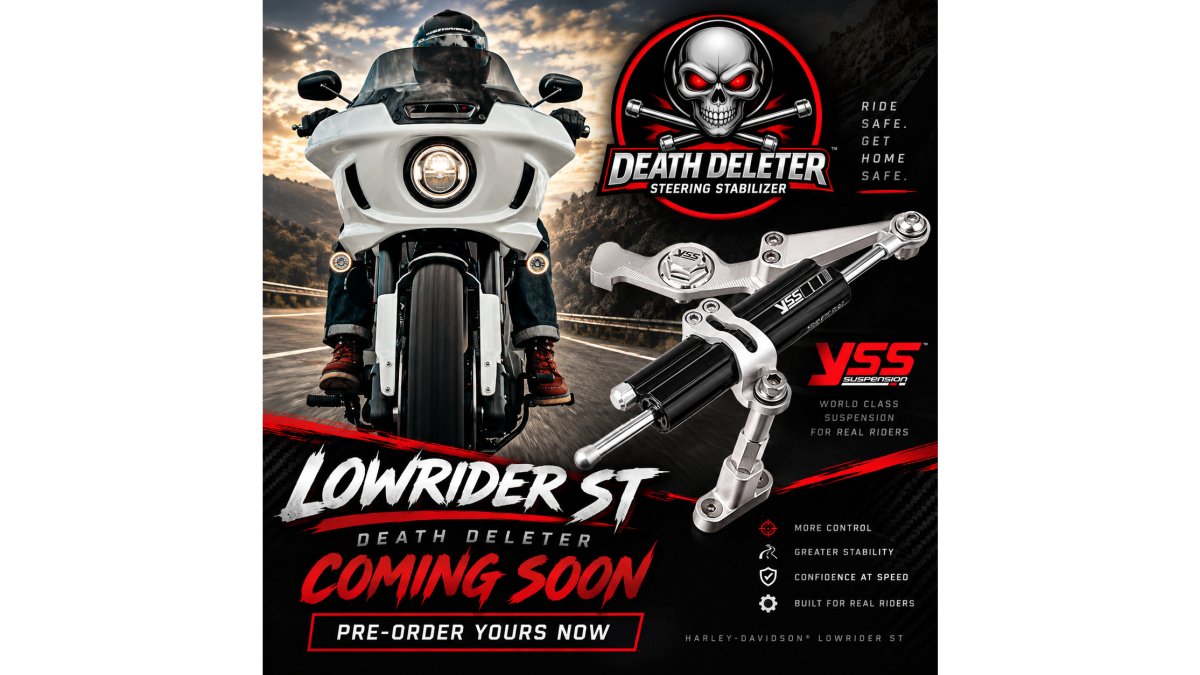
- Death Deleter Road Glide and Street Glide steering stabilizer kits are each priced at $675.
Table of Contents
- What a Steering Damper Does and Where It Mounts
- What Does a Motorcycle Fork Brace Do?
- Steering Damper vs Fork Brace: What Each Component Controls
- Motorcycle Steering Wobble Causes and Fixes
- Motorcycle Steering Damper Benefits and Trade-Offs
- Diagnose Before You Buy: Setup Checks and Symptom-Based Decision Guide
- Choosing Your Harley Stabilizer Kit for Your Model
- Frequently Asked Questions
What a Steering Damper Does and Where It Mounts
Last Updated: November 4, 2026
A steering damper is a hydraulic device that resists rapid turning of the handlebars and front wheel. On a Harley-Davidson touring bike, it sits between the frame and the front fork tubes, so it works against sudden steering movements rather than changing how the bike is steered at normal speeds. The Death Deleter kits pair a rebuildable YSS damper with mounting hardware matched to each model.
Riders most often think about a damper when a bike starts to oscillate, the wobble that builds at speed and can turn into a violent side-to-side motion. The damper absorbs that energy before it grows.
Where it mounts matters. The Death Deleter Low Rider and Softail kit mounts on top of the triple tree, between the gas tank and the triple tree. The fitment differs from model to model, so the mounting point should be confirmed before purchase.
What Does a Motorcycle Fork Brace Do?
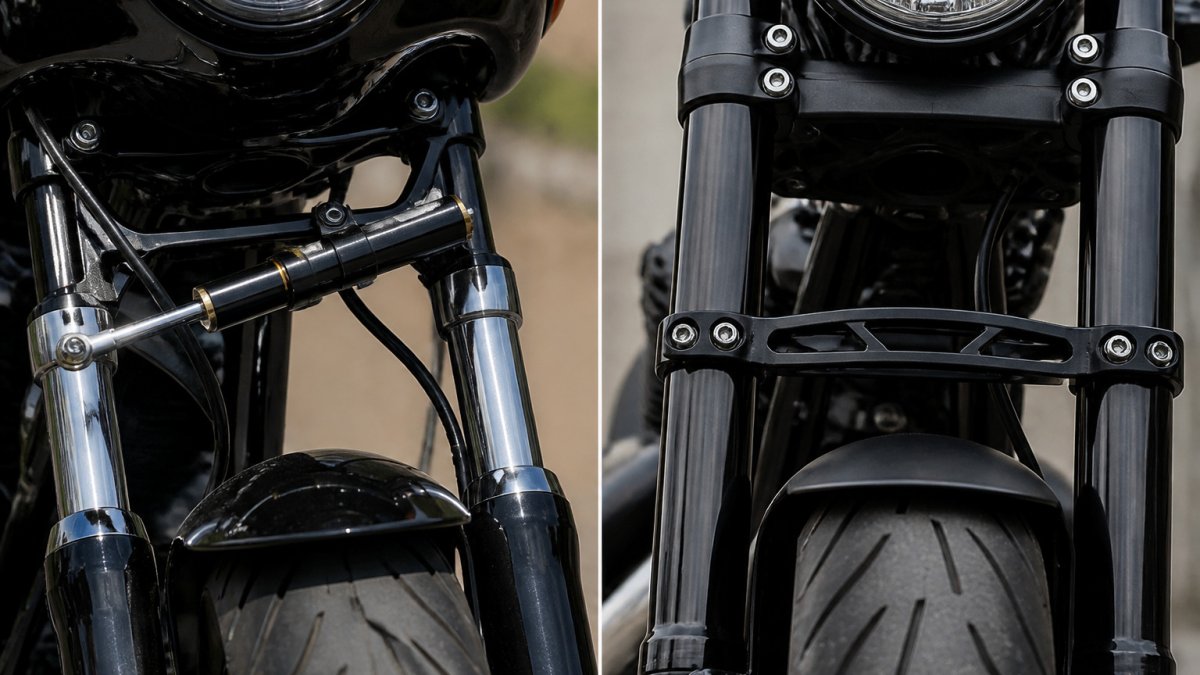
A fork brace is a bar that connects the two front fork legs together, usually near the axle or lower triple clamp. Its job is to stop the fork legs from twisting relative to each other under load. Less twist means the front wheel stays more directly under the handlebars.
A brace does not act on steering movement itself. It addresses fork flex and torsional rigidity, which is why it is often recommended for bikes that feel vague or deflect over bumps and rough road surfaces.
Steering Damper vs Fork Brace: What Each Component Controls
The two parts solve different problems, and that is the main reason riders confuse them. The cleanest way to separate them is to ask what each one actually resists.
A steering damper is a velocity-sensitive hydraulic device. It resists how fast the steering assembly rotates, not how far. When the front wheel tries to snap left-right-left in a rapid oscillation, the damper's piston is forced through an orifice, and hydraulic resistance rises with shaft speed. Slow, deliberate steering inputs at parking-lot speed pass through with little resistance; fast, violent inputs at highway speed meet much more. That is why a damper is the direct countermeasure to handlebar oscillation and tank slappers, and why it does essentially nothing for a fork that is flexing under braking or cornering load.
A fork brace is a structural part. It ties the two fork legs together, typically near the axle or just under the lower triple clamp, and reduces how much the legs can twist relative to each other and how much the assembly can splay under load. The brace changes stiffness, not damping. It does not care how fast the bars are moving; it cares how much bending and torsional load the fork is seeing. That is why a brace helps front-end feel, deflection over rough surfaces, and braking stability, but will not stop an oscillation once it has started.
| Component | What it resists | How it works | What it does not fix |
|---|---|---|---|
| Steering damper | Steering velocity (how fast the bars turn) | Hydraulic orifice resists rapid piston movement | Fork flex, worn bearings, bad tires |
| Fork brace | Relative fork-leg flex and twist | Structural tie between the two fork legs | Oscillation, steering-head play, imbalance |
Steering damper
- Pros: Directly resists the rapid steering movement that feeds wobble; adjustable on rebuildable units; effective across a wide speed range.
- Cons: Does nothing for fork flex; mounting is model-specific; adds some steering resistance, most noticeable at low speed.
Fork brace
- Pros: Improves fork torsional rigidity and front-end feel; simple bolt-on on compatible forks; helps with deflection over rough roads.
- Cons: Does not stop oscillation once it starts; fit varies by fork diameter and design; benefit depends on how much flex the original fork already has.
A useful mental model: the damper manages motion, the brace manages structure. For a deeper guide on choosing a rebuildable damper for baggers, see rebuildable damper guide for baggers. If the bars are moving when they should not, think damper. If the front end feels vague or deflects without the bars oscillating, think brace. Many riders end up needing one, the other, or neither once they diagnose the actual symptom, which is why the next section starts with checks rather than parts.
Motorcycle Steering Wobble Causes and Fixes
Wobble usually has more than one cause. For a dedicated walkthrough of the causes and remedies, see dedicated wobble fix guide. Worn steering head bearings, incorrect tire pressure, loose triple clamp bolts, unbalanced wheels, and modifications that change weight distribution can all contribute.
Start with the basics: check tire pressure and condition, confirm the wheel is balanced, inspect the steering head bearings, and make sure all clamp fasteners are torqued to specification. If the wobble persists after those checks, a damper is a reasonable next step. Reducing the cause is still the first priority, because a damper controls the symptom.
Death Deleter Harley-Davidson Road Glide & CVO Steering Stabilizer 2015–2026 →
Motorcycle Steering Damper Benefits and Trade-Offs
The main benefit of a steering damper is that it resists rapid steering movement.
The trade-offs are real. A damper adds some resistance to steering, which some riders feel at parking speeds. Setup matters: a damper that is too stiff can feel heavy, while one that is too soft will not control oscillation. Rebuildable units let you tune the damping, but that takes time and attention.
Diagnose Before You Buy: Setup Checks and Symptom-Based Decision Guide
Diagnosing the cause before buying a part is a sensible first step. Run the checks below before spending money on hardware.
Baseline checks, in order
- Tires and wheels: Confirm cold tire pressure against the placard, inspect for cupping or uneven wear, and verify wheel balance. A cupped front tire can produce a wobble that feels exactly like a damper problem.
- Steering head bearings: With the front wheel off the ground, feel for notchiness or play through the bars. A brinelled bearing race is a common cause of deceleration wobble.
- Clamp and axle fasteners: Confirm triple clamp, axle, and fork-tube fasteners are torqued to specification and in the correct sequence.
- Fork alignment and suspension settings: Check that fork tubes sit evenly in the clamps and that sag and rebound are set for the rider's weight and load. A fork that is binding or set too stiff can feel like flex.
- Loading and modifications: Added luggage, a fairing change, or a passenger can shift weight distribution and expose a wobble that was always there.
Symptom-to-cause map
| Symptom | Likely cause | Reasonable next step |
|---|---|---|
| Bars oscillate at highway speed, especially on decel | Steering-head bearing wear, tire cupping, imbalance | Fix the maintenance item first; damper if it persists after checks |
| Front end feels vague or deflects over bumps | Fork flex, worn bushings, suspension settings | Inspect fork; brace if flex is confirmed on a compatible fork |
| Bars feel heavy or notchy at low speed | Over-tight steering head, damper set too stiff | Recheck bearing preload and damper setting |
| Wobble appears only after a load change | Weight distribution, tire pressure | Recheck pressure and sag before adding parts |
Trade-offs to weigh before buying
A damper adds steering resistance, and a unit set too stiff can make low-speed maneuvering tiring and can dull feedback. A brace can change how the fork responds over sharp bumps and, on some forks, will not fit without modification. Neither part is an unconditional upgrade: both can mask a mechanical fault that will keep getting worse. Correct installation matters as much as the part, a damper mounted with misaligned hardware or a brace torqued unevenly can introduce the very problem it was meant to solve.
Use the checks and the symptom map in that order. If the symptom points to a maintenance issue, fix that first. If it points to oscillation that survives the checks, a damper is the more direct fix. If it points to flex or deflection on a compatible fork, a brace is the more direct fix. Only after that triage should you start matching a kit to your model.
Choosing Your Harley Stabilizer Kit for Your Model
Match the kit to your bike before ordering:
- Road Glide and CVO Road Glide (2015-2026): The Death Deleter Harley-Davidson Road Glide & CVO Steering Stabilizer 2015-2026 costs $675 and includes three shims for 49-62 mm forks, plus a black YSS damper. Pick Gold, Black, or Clear Anodized hardware.
- Street Glide (2015-2026): The Death Deleter Harley-Davidson Street Glide Steering Stabilizer 2015-2026 is also $675 and covers standard and CVO models with conventional or inverted forks.
- Low Rider and Softail: The Death Deleter Harley-Davidson Low Rider & Softail Steering Damper Kit is available for pre-order at $675, with release expected by early December 2026. Its release window is an estimate and may change.
Our Death Deleter steering stabilizers overview compares the kits across models if you are unsure which applies to your bike.


Frequently Asked Questions
Is a steering damper the same as a stabilizer?
In motorcycle usage, the two terms are often used interchangeably. Both refer to a hydraulic damper mounted between the frame and the front fork or triple tree that resists rapid steering movement. The practical difference lies in the mounting hardware and kit design rather than the principle. When comparing products, check the mounting location, the damper model, and whether the kit is built for your specific fork type, such as a standard or inverted fork setup on a Road Glide or Street Glide.
Does a steering damper prevent death wobble?
A steering damper resists rapid steering oscillation, which is the mechanism behind the high-speed wobble many riders call death wobble. It does not remove the underlying cause, so if the wobble comes from worn bearings, incorrect tire pressure, loose fork clamps, or chassis geometry problems, those need checking first. The Death Deleter Road Glide and Street Glide kits, at $675 each, include a YSS damper.
Can you use a fork brace and a steering damper together?
Some riders run both, because a fork brace stiffens the fork legs against twisting while a steering damper controls rapid steering input. Stacking the two adds complexity, so check that the damper bracket does not interfere with the brace and that the front end still moves freely at low speed. Start by fixing any slack or worn components, then add one component at a time and test the effect on a known route before adding the second.
How do I know whether my motorcycle needs a steering damper or a fork brace?
If the front end oscillates rapidly and the handlebars shake, a steering damper addresses that rapid steering movement directly. If the fork legs flex or twist noticeably under braking or cornering and the front end feels vague, a fork brace targets torsional rigidity. Rule out loose clamps, worn steering head bearings, and uneven tire pressure first, since these produce similar symptoms. Matching the fix to the symptom avoids paying for a component that does not address your specific problem.
