
Table of Contents
- What Is a Motorcycle Chain Tensioner and Why It Matters
- Automatic Motorcycle Chain Tensioner vs Manual Adjustment
- How to Measure and Set Motorcycle Chain Adjustment
- Spring-Loaded Tensioner Materials and Construction
- Motorcycle Chain Tensioner Installation: Step-by-Step
- Harley-Davidson Chain Tensioner Fitment and Compatibility
- Safety Checks and Maintenance for Chain Tension Control
- Frequently Asked Questions
Last Updated: October 5, 2026
What Is a Motorcycle Chain Tensioner and Why It Matters
A motorcycle chain tensioner is a mechanical device that maintains consistent pressure on your chain as it naturally stretches and loosens during use. Unlike manual adjusters that require frequent intervention, a tensioner automatically compensates for slack, keeping your chain running under proper tension without constant maintenance stops.

Why does this matter? A loose chain can derail, slip off sprockets, or fail entirely. At highway speeds, chain failure means loss of power delivery to the rear wheel, and potentially a dangerous loss of control. A properly tensioned chain ensures smooth power transmission, reduces wear on both the chain and sprockets, and improves overall drivetrain efficiency.
Death Deleter specializes in performance upgrades for Harley-Davidson touring motorcycles, including spring-loaded chain tensioners designed to handle the demands of street and track use. Our approach addresses a real problem: touring bikes with upgraded engines and aggressive riding styles experience accelerated chain stretch, making manual adjustment impractical.
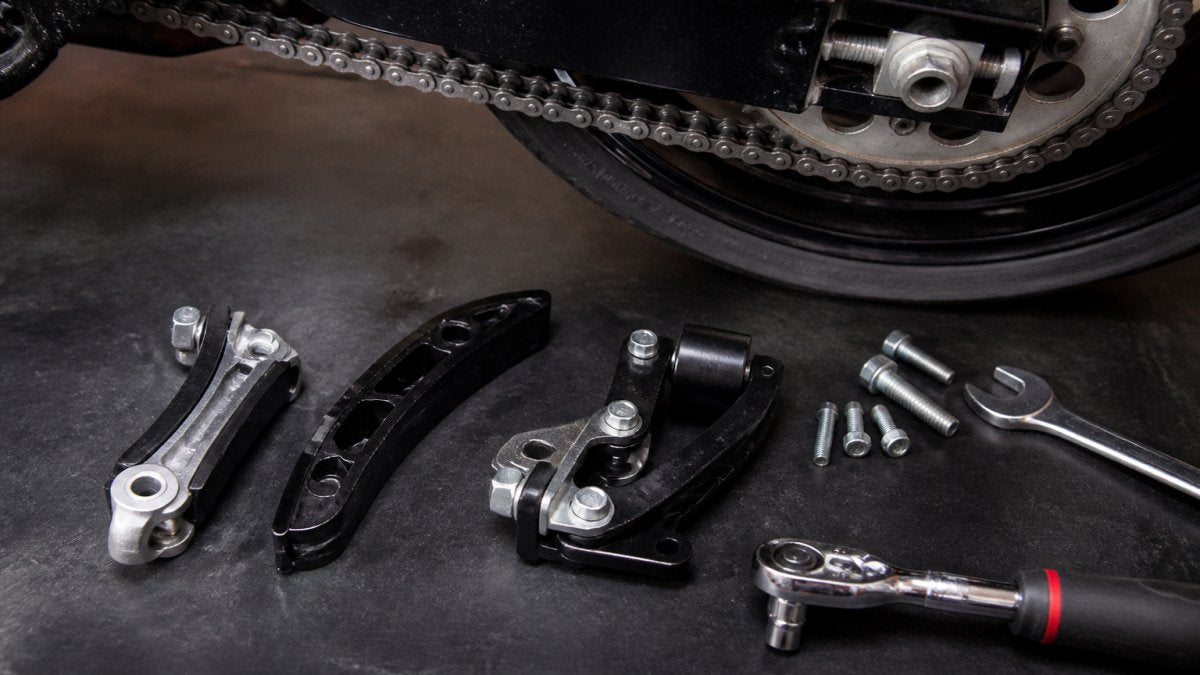
The tensioner sits between your swingarm and the chain, applying pressure through a roller wheel. As your chain loosens, the spring mechanism pushes the wheel harder against it, maintaining tension automatically. This is especially valuable for performance riders who've added horsepower through big bore kits or tuning, higher power output means faster chain wear and more frequent slack.
Automatic Motorcycle Chain Tensioner vs Manual Adjustment
The core difference comes down to maintenance burden and consistency. Manual adjustment requires you to stop, measure chain slack, loosen bolts on the rear wheel or swingarm, shift the wheel forward or backward, retighten everything, and verify alignment. This process takes 15-30 minutes and must be repeated every few hundred miles on a hard-ridden bike.
An automatic motorcycle chain tensioner eliminates that cycle. The spring-loaded mechanism continuously adjusts as slack develops, so you check tension periodically but rarely need to make manual corrections. For riders doing weekend track days or pushing their bikes hard on the street, this difference is significant.
However, automatic tensioners aren't a complete replacement for maintenance. You still need to inspect the chain regularly for wear, check that the tensioner's roller wheel moves freely, and ensure the mechanism hasn't bottomed out (a sign your chain is too worn). A tensioner manages slack, it doesn't resurrect a chain that's reached the end of its service life.
Manual adjustment remains relevant for certain riders. If you ride casually, stick to moderate speeds, and prefer hands-on control over your bike's setup, manual adjustment works fine. You'll simply spend more time on maintenance. But for performance-oriented riders running upgraded engines, manual adjustment becomes a chore that pulls you away from riding.
The trade-off is simple: automatic tensioners trade one-time installation and occasional inspection for freedom from frequent adjustments.
How to Measure and Set Motorcycle Chain Adjustment
Before installing any tensioner, you need to understand what proper chain tension looks like. Chain slack is measured at the midpoint of the lower run, the section between the rear sprocket and the countershaft sprocket.
Measuring chain slack correctly:
Place your motorcycle on a center stand on level ground. Locate the tightest point in the chain's rotation by rolling the rear wheel slowly and feeling for resistance. Mark that spot. Then measure the vertical play at that point by pushing up on the lower run of the chain. Most manufacturers specify 1.0 to 1.5 inches of vertical movement as the target range.
Too loose: The chain risks jumping sprockets, derailing, or slipping under load. At highway speeds, a loose chain can cause sudden power loss or catastrophic failure.
Too tight: Excessive tension accelerates wear on the chain, sprockets, and wheel bearings. It also increases friction, robbing power and fuel economy.
Once you've measured, compare your findings to your motorcycle's service manual. Harley-Davidson touring models typically specify 1.0 to 1.5 inches of slack, but some models vary. Always defer to your specific year and model documentation.
If your chain is outside the specified range, you'll need to adjust it. With a manual system, you'll loosen the rear axle nut, shift the wheel forward or backward using the adjusters on the swingarm, and retighten.
Spring-Loaded Tensioner Materials and Construction
The durability and performance of a motorcycle chain tensioner depend heavily on how it's built. Most quality tensioners use aluminum alloy for the main body because it's lightweight, resists corrosion, and dissipates heat well.
The spring mechanism is the heart of the system. A torsion spring provides the pushing force that keeps pressure on the chain as slack develops. The spring must be strong enough to maintain tension throughout the chain's useful life but not so stiff that it bottoms out prematurely or becomes difficult to install.
Quality matters here. A weak spring loses effectiveness quickly. An oversized spring can prevent proper chain alignment or create binding. Death Deleter's spring-loaded tensioner uses a precisely calibrated torsion spring matched to Harley-Davidson touring applications, ensuring consistent performance across the chain's stretch cycle.
The mounting hardware, bolts, brackets, and attachment points, should be stainless steel or plated to resist corrosion. Touring bikes spend time in all weather conditions, and rust on mounting hardware can make future adjustments or removal difficult.
Finish options also matter for durability. Anodized aluminum resists oxidation and corrosion far better than bare aluminum. Death Deleter offers three finish options, Gold, Black, and Clear Anodized, all providing equal protection and all priced at $399.00. Choose based on aesthetics; the protection level is the same across all three.
Motorcycle Chain Tensioner Installation: Step-by-Step
Installing a motorcycle chain tensioner requires basic mechanical skill and standard tools: a socket set, wrenches, and a torque wrench for final fastening. Most riders can complete the installation in 1-2 hours.
Step 1: Prepare your workspace and bike. Place your motorcycle on a center stand on level ground.
Step 2: Measure and mark the current chain tension. Before making any changes, measure your chain slack at the midpoint of the lower run and record it.
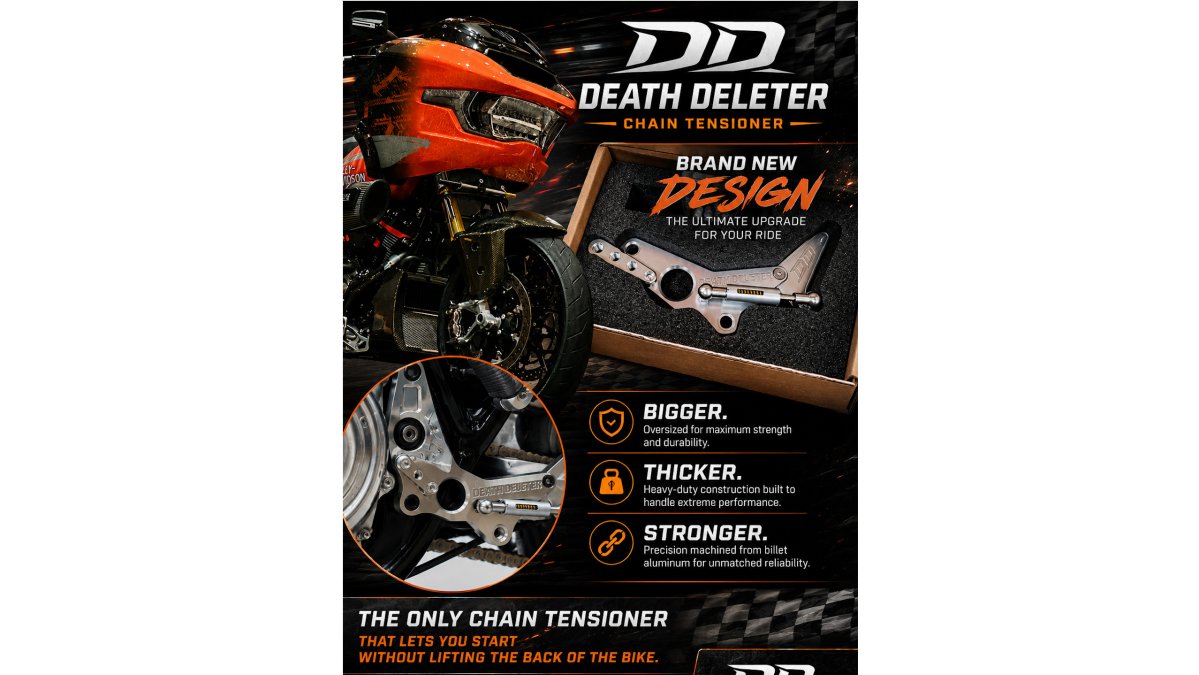
Step 3: Position the tensioner. Identify the mounting point on your swingarm. For Harley-Davidson touring models from 2015 and newer, Death Deleter's tensioner mounts to a specific location on the rear swingarm.
Death Deleter Harley-Davidson Touring Chain Tensioner →
Step 4: Secure the mounting bolts. Insert the bolts through the tensioner bracket and into the swingarm.
Step 5: Verify chain alignment and tension. Spin the rear wheel slowly and observe the chain's path. It should track straight through the sprockets without pulling to either side.
Step 6: Final check and test ride. Torque all fasteners to specification.
Harley-Davidson Chain Tensioner Fitment and Compatibility
Not all chain tensioners fit all bikes. Fitment depends on swingarm design, chain routing, and mounting point location, all of which vary by model year and model line.
Death Deleter's motorcycle chain tensioner is engineered specifically for Harley-Davidson touring models from 2015 and newer. This compatibility window includes Road Glide, Street Glide, and CVO Touring variants. The tensioner's mounting bracket and roller wheel geometry are tuned to these specific swingarm designs.
Before purchasing, verify your bike's year and model against the compatibility list. If you own a 2014 or earlier model, or a non-touring Harley-Davidson, this tensioner won't fit, different swingarm designs require different mounting solutions. Attempting to force a mismatched tensioner onto an incompatible bike risks poor alignment, premature wear, and potential chain failure.
Fitment verification should happen before installation. Check the product listing at Death Deleter for your specific model year, and review the included fitment documentation. If you're uncertain, contact Death Deleter's support team before ordering, a wrong purchase wastes time and money.
Compatibility also matters if you've modified your bike. Aftermarket swingarms, custom frame geometry, or non-standard chain routing can affect tensioner fitment. If you've made significant modifications, measure your swingarm and chain path before assuming the tensioner will work.
Safety Checks and Maintenance for Chain Tension Control
A motorcycle chain tensioner isn't a "set and forget" component. Regular inspection catches problems before they become dangerous.
Monthly inspection routine:
Check that the roller wheel spins freely. Grab the tensioner and try to move it side to side, there should be minimal play.
Measure chain slack at the tightest point. Record the measurement and compare it to your previous checks.
Inspect the mounting bolts for looseness. Vibration from the engine and drivetrain can gradually loosen fasteners. A loose tensioner won't maintain consistent pressure and can rattle or cause noise.
Signs of incorrect chain tension:
A chain that's too loose will make a rattling or slapping noise, especially during acceleration.
A chain that's too tight produces a high-pitched whine or whirring sound and may cause vibration through the frame. You'll notice reduced fuel economy and increased wear on the chain and sprockets.
Misalignment shows up as uneven wear on the chain and sprockets. Inspect the sides of the chain teeth; they should wear evenly.
When to replace the chain:
A motorcycle chain has a finite service life. As it stretches, the pitch between links increases, causing it to sit higher on the sprocket teeth.
Most chains last 15,000 to 30,000 miles depending on maintenance, riding style, and riding conditions. A tensioner can't extend this lifespan; it can only manage slack during the chain's useful life.
A tensioner cannot guarantee against chain breakage or replace a worn or damaged chain. Proper installation, chain adjustment, and regular inspection remain essential.
Keeping your motorcycle chain properly tensioned is non-negotiable for safety and performance. Built from 6061 aluminum with a calibrated torsion spring, our tensioner is engineered for Harley-Davidson touring models from 2015 and newer. Shop Death Deleter's chain tensioner and ride with the confidence that your drivetrain is under control.
Frequently Asked Questions
How do you know if your motorcycle chain tensioner is failing?
A failing motorcycle chain tensioner shows signs of excessive chain slack that develops quickly, even after recent adjustment. You may notice the chain rubbing against the swingarm, hear metallic grinding sounds, or see uneven wear on the chain and sprockets. If a spring-loaded tensioner stops maintaining consistent pressure, the roller wheel may not move freely or the torsion spring may have lost its resistance. Inspect the tensioner for cracks, rust, or bent mounting hardware. Proper chain tension should allow 1 to 1.5 inches of vertical slack at the midpoint of the lower run, if you're adjusting more frequently than every few rides, the tensioner needs replacement.
What's the difference between automatic and manual motorcycle chain adjustment?
Manual adjustment requires you to loosen the rear axle, move the wheel forward or backward to change tension, then retighten, a time-consuming process that must be repeated as the chain stretches. Automatic motorcycle chain tensioners use a spring-loaded mechanism or hydraulic pressure to apply constant force against the chain, reducing slack as it develops without rider intervention. Automatic tensioners are ideal for performance riding and track use where consistent chain tension improves efficiency and reduces wear. Manual adjustment works for casual street riders but demands discipline and frequent checks. The Death Deleter Harley-Davidson Touring Chain Tensioner uses a spring-loaded design with a roller wheel that automatically maintains pressure, eliminating the need for manual readjustment during normal use.
How often should you check motorcycle chain tension?
Check chain tension every 500 to 1,000 miles or before long rides. New chains stretch faster, so inspect weekly for the first 500 miles. Look for slack at the midpoint of the lower run, it should measure 1 to 1.5 inches of vertical movement. Chains stretch gradually during use, especially under high-speed or performance riding. If you ride frequently or push your bike hard, check every 300 miles. Spring-loaded tensioners reduce the frequency of manual adjustments, but they don't eliminate the need for visual inspection. A worn or damaged chain may stretch beyond the tensioner's capacity and require replacement. Regular checks catch problems before they cause chain derailment or failure.
Can a motorcycle chain tensioner prevent a chain from breaking?
A motorcycle chain tensioner maintains proper tension and reduces excessive slack, which helps prevent chain derailment and extends chain life by promoting even wear. However, it cannot prevent breakage caused by a worn, damaged, or defective chain itself. A tensioner is a control device, not a replacement for regular chain inspection and maintenance. If your chain is near the end of its service life, has stiff links, visible rust, or damage, a tensioner will not save it. Proper installation, correct tension settings, and regular cleaning and lubrication remain essential. The Death Deleter Chain Tensioner is designed for street and track use on Harley-Davidson touring models 2015 and newer, but it requires that you maintain your chain properly and replace it when worn.