
Table of Contents
- Does Installing a Chain Tensioner Void Your Harley Warranty?
- How the Magnuson-Moss Warranty Act Protects Aftermarket Parts
- Understanding Harley-Davidson Aftermarket Parts Warranty Coverage
- Recognizing Harley Cam Chain Tensioner Symptoms and Wear
- Chain Tensioners vs. Chain Conversion Kits: Warranty Implications
- Proving Causation: How Dealers Decide Warranty Claims
- Your Claim Evidence Checklist and Next Steps
- Frequently Asked Questions
Last Updated: October 19, 2026
Does Installing a Chain Tensioner Void Your Harley Warranty?
The short answer is no, not automatically. Whether a chain tensioner warranty is affected depends on whether it caused the specific failure you're claiming, a distinction written into federal law.
At Death Deleter, we work with riders who've invested in performance upgrades.

This guide covers how coverage works, what triggers denials, and how to protect yourself when modifying your bike.
How the Magnuson-Moss Warranty Act Protects Aftermarket Parts
The Magnuson-Moss Warranty Act, passed in 1975, prevents manufacturers from voiding warranties simply because you installed a third-party component.
Your dealer cannot point to an aftermarket intake and deny coverage for a transmission issue.
The burden of proof rests with Harley-Davidson. They must demonstrate causation, not just point to the modification and say no.
Federal Trade Commission guidance on manufacturer warranties and aftermarket parts
Understanding Harley-Davidson Aftermarket Parts Warranty Coverage
Harley-Davidson's warranty covers factory defects and mechanical failures under normal use. After a modification, coverage depends on whether the modification relates to the failure.
Factory warranty typically covers:
- Engine components that fail due to defects
- Transmission and drivetrain issues
- Electrical systems
- Cooling systems
Factory warranty does NOT cover:
- Wear items (chains, sprockets, brake pads)
- Damage from improper maintenance
- Failures caused by performance modifications
- Damage from racing or extreme use
A chain tensioner sits in a gray area. If it damages the cam chest, Harley can deny coverage for that damage.
Many riders also carry extended service contracts, which often have stricter modification clauses than factory warranty.
Recognizing Harley Cam Chain Tensioner Symptoms and Wear
A healthy cam-chain tensioner maintains consistent pressure on the timing chain, compensating as it stretches. Over time the internal spring weakens slightly, also normal wear.
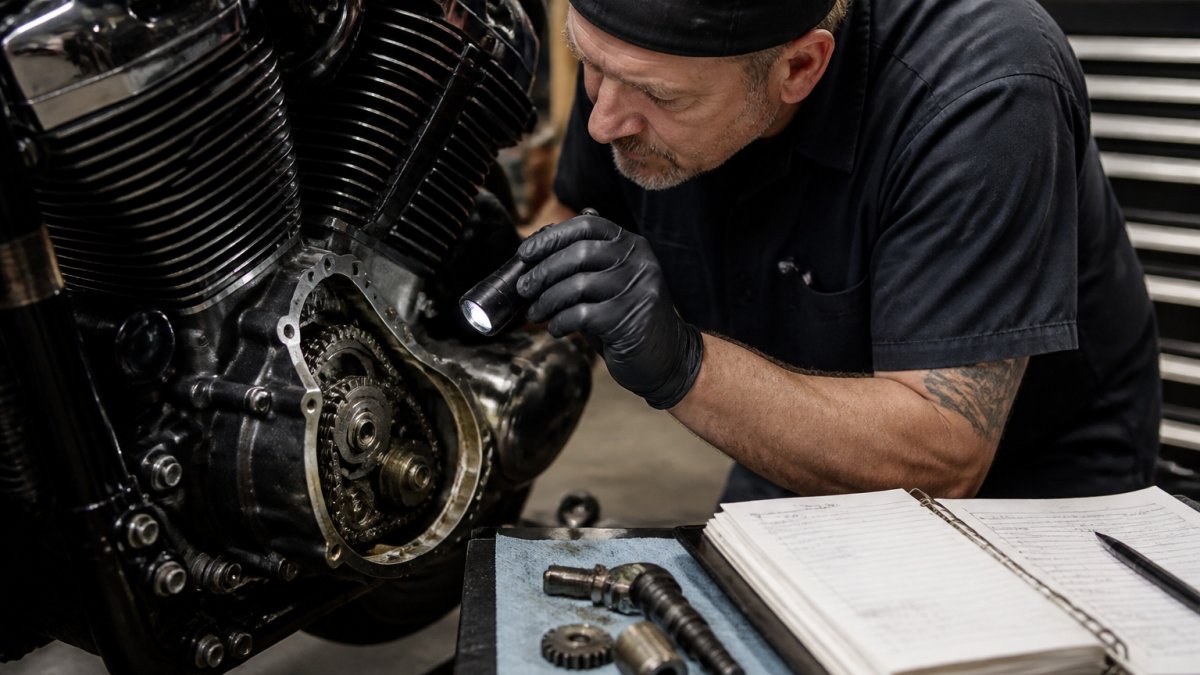
Signs of normal wear:
- Chain develops slight slack between service intervals
- Tensioner requires occasional adjustment
- No noise or vibration changes
- No visible leaks or damage
Signs of tensioner failure:
- Loud rattling or grinding from the cam chest
- Sudden loss of chain tension
- Metal debris in the oil
- Visible damage to the cam chest or adjacent components
A failed tensioner can cause catastrophic damage.
Tensioner Design Varies by Engine Family and Model Year
Tensioner style, inspection intervals, and wear patterns differ across Twin Cam, Milwaukee-Eight, and Evolution-era designs, and even within a family as running changes were introduced.
Pull the service manual for your exact model year and engine family and check the inspection interval and wear limits. If the bike is under factory warranty, the dealer can confirm which service bulletin applies to your VIN.
Symptoms, Inspection, and Immediate Safety Steps
If you notice rattling, grinding, or a sudden change in cam-chest noise, treat it as a stop-and-inspect condition. A tensioner that lost preload can let the chain jump timing, and valve-to-piston contact turns a contained repair into a top-end rebuild.
A practical sequence when symptoms appear:
- Stop riding and do not start the engine again until the cam chest has been inspected. Continued operation with a loose chain can spread metal debris through the oil system.
- Check the oil for glitter or metallic sheen. Drain a small sample into a clean container and inspect it in daylight. Metal debris is a red flag for tensioner or chain-guide wear.
- Do not adjust or replace the tensioner yourself if the bike is under warranty and you intend to file a claim. Have a dealer or an independent shop document the condition first with photos and a written finding.
- Ask the technician to record the chain tension, guide condition, and any debris found, and to note whether the condition is consistent with normal wear or a defect.
- Keep the failed parts. Do not let anyone discard the tensioner, chain, or guides before the claim is resolved; they are the physical evidence.
This is where causation becomes critical. If your tensioner failed from a manufacturing defect, Harley should cover the damage. If your aftermarket tensioner failed from incorrect installation or incompatibility, they can deny coverage.
Chain Tensioners vs. Chain Conversion Kits: Warranty Implications
Two approaches exist for chain management: spring-loaded tensioners and complete chain conversion kits. Their warranty implications differ significantly.
A spring-loaded chain tensioner is a bolt-on component that maintains tension as your existing chain stretches, and understanding chain tensioner warranty coverage is essential before installation.
Warranty treatment differs:
Spring-loaded tensioners:
- Viewed as maintenance aids, similar to oil filters or air filters
- Less likely to trigger claim denials if unrelated failures occur
- Easier to prove causation if the tensioner itself fails
- Dealer can inspect and determine if the tensioner caused damage
Chain conversion kits:
- Viewed as major modifications
- Dealers scrutinize related failures more carefully
- More likely to be cited as reason for denial on related systems
- Harder to prove the kit didn't contribute to an unrelated failure
Install a chain tensioner and suffer an unrelated engine failure months later, and the tensioner probably won't disqualify you.
Death Deleter Harley-Davidson Touring Chain Tensioner →
The key difference: tensioners enhance your existing system. Conversion kits replace it. Dealers treat replacements as more significant modifications.
Proving Causation: How Dealers Decide Warranty Claims
When you file a warranty claim on a modified bike, the dealer's service manager must decide whether the modification caused the failure.
The dealer inspects the failed component and the modification for damage, improper installation, or incompatibility, and reviews your service history and maintenance records.
Here's what dealers examine:
Direct damage:
- Is the failed part physically damaged by the modification?
- Are there scratch marks, bent components, or impact damage?
- Does the damage pattern match how the modification could have caused it?
Maintenance records:
- Did you perform regular oil changes?
- Did you maintain proper chain tension before installing the tensioner?
- Are there service records showing the component was healthy before the modification?
Installation quality:
- Was the modification installed correctly?
- Did you follow the manufacturer's instructions?
- Are there signs of improper installation (wrong fasteners, misalignment, damage to surrounding components)?
Timing:
- When did you install the modification?
- When did the failure occur?
- Did the failure happen immediately after installation or months later?
A dealer cannot deny your claim on suspicion, they need evidence.
But if an incorrect tensioner damages the cam chest immediately, causation is clear and they can deny coverage for that damage.
Why a Tensioner Replacement Is Not the Same as an Unrelated Modification
Most warranty discussions lump every aftermarket part together. That is a mistake, and the most useful distinction for a rider asking whether a chain tensioner voids coverage.
A tensioner replacement is a targeted cam-chest intervention: it does not reprogram the ECU, change displacement, alter the exhaust, or add boost. That narrow scope cuts both ways:
- If the claimed failure is outside the cam chest, a transmission issue, a charging-system fault, a cooling problem, the tensioner is very unlikely to be the cause, and the dealer should be able to say so in writing.
- If the claimed failure is inside the cam chest, chain, guides, cams, oil pump, the tensioner is squarely in the causation picture, and the dealer will look closely at installation and compatibility.
A complete chain conversion kit is different: it replaces the system rather than maintaining it, and dealers reasonably scrutinize related failures more carefully.
A Claim-Evidence Checklist for a Disputed Tensioner Claim
If a claim is denied or heading that way, move the discussion from opinion to record. Assemble the following:
- The written denial, stating the failed component and the specific reason coverage was refused
- The dealer's inspection notes, including chain tension measurements and any debris found
- Photos of the failed component before it is discarded
- Your installation records: date, mileage, part number, and the instructions you followed
- Your maintenance log showing oil changes and prior tensioner inspections at the specified intervals
- The service manual or bulletin page showing the inspection interval you followed
- A written statement from the installing technician, if a shop did the work
With that package, escalate in writing. Ask Harley-Davidson corporate customer service to review the denial and identify the evidence linking the tensioner to the failure. A denial that cannot point to specific evidence is most often reconsidered. If the repair cost is significant and the denial stays vague, a consumer-protection attorney who handles warranty disputes can review the file; many offer an initial consultation.
Magnuson-Moss Warranty Act enforcement guidance from the Federal Trade Commission
Your Claim Evidence Checklist and Next Steps
Before filing a warranty claim on a modified bike, gather documentation that shifts the burden toward Harley to prove causation.
Documentation to collect:
- Original purchase receipt and warranty paperwork
- Service records showing maintenance history before modification
- Oil change receipts and dates
- Chain maintenance logs (tension checks, adjustments, replacements)
- Photos of the modification installation (before, during, after)
- Installation instructions you followed
- Receipts for the aftermarket part (proves it's a legitimate product)
When filing your claim:
- Be honest about the modification. Hiding it will backfire if the dealer discovers it during inspection.
- Explain why the modification didn't cause this specific failure. Use your evidence.
- Reference the Magnuson-Moss Warranty Act if the dealer cites the modification as automatic grounds for denial.
- Ask the service manager to document their reasoning in writing. If they deny coverage, get the denial in writing with specific reasons.
- If denied, contact Harley-Davidson corporate. Many denials are overturned at this level.
If your claim is denied:
You have options. Request a written explanation of the denial. Ask which component failed and how the modification caused it.
Consider a consumer protection attorney if the denial involves a large repair cost; many specialize in warranty disputes and can apply pressure that changes outcomes.
Your Harley warranty is more resilient than many riders believe.
If you're considering a chain tensioner to maintain chain control and prevent slack, the Death Deleter Harley-Davidson Touring Chain Tensioner is engineered for this purpose. With proper installation and maintenance records, a quality tensioner enhances reliability without jeopardizing your warranty protection. Shop the Death Deleter chain tensioner and ride with confidence knowing your chain stays under control.
Frequently Asked Questions
Can an aftermarket chain tensioner void my Harley warranty?
Not automatically. Under the Magnuson-Moss Warranty Act, Harley cannot deny a warranty claim simply because you installed an aftermarket chain tensioner. They must prove the tensioner directly caused the failure. However, if the tensioner caused damage to the cam chest, timing chain, or oil pump, Harley may deny coverage for that specific damage. The key is whether there's a causal connection between the modification and the failure.
What are the symptoms of a bad cam chain tensioner on a Harley?
A failing cam chain tensioner typically produces a rattling noise from the cam chest at startup or idle, especially in cold conditions. You may hear a metallic grinding sound that worsens under load. Some riders report rough idle, difficulty starting, or check engine lights. If the tensioner fails completely, metal debris can circulate through the oil, potentially damaging the oil pump and cam components. Immediate inspection is critical if you hear these symptoms.
Does a chain conversion kit affect my Harley warranty?
A chain conversion kit may affect warranty coverage differently than a tensioner. If you convert from belt to chain or upgrade to a different chain system, Harley may scrutinize related component failures more closely. They will likely argue that any failure in the converted system is related to your modification. Document your installation carefully, maintain service records, and keep proof that the failure is unrelated to the conversion if you file a claim.
What should I do if Harley denies my warranty claim after I installed an aftermarket part?
Request a written explanation of the denial citing the specific failure cause and how your modification caused it. Review your warranty documents and the Magnuson-Moss Act requirements. If you believe the denial is unjustified, file a complaint with the Federal Trade Commission or consult a consumer protection attorney. Many dealers will reconsider if you provide evidence that the failure occurred naturally and is unrelated to your aftermarket part.